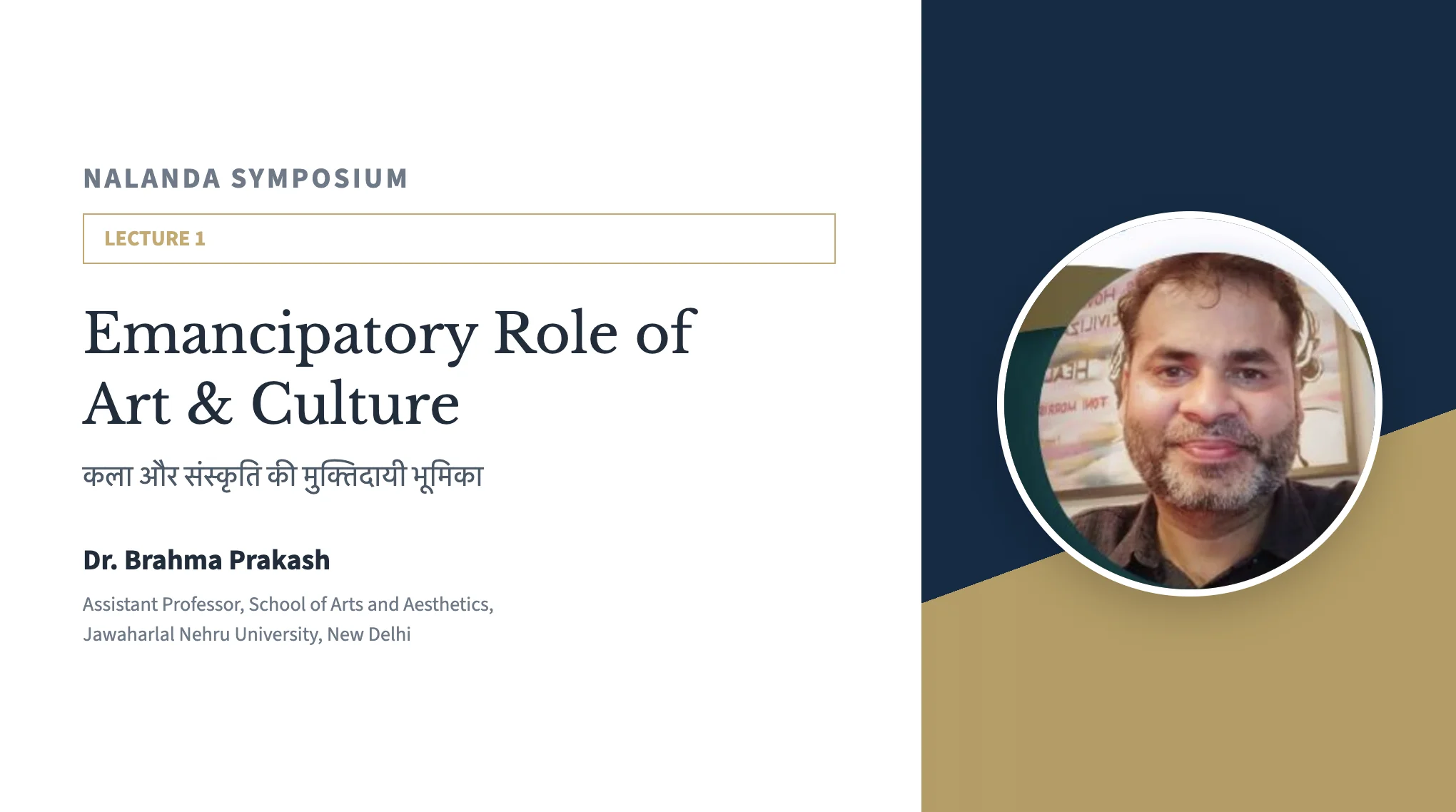
How Art and Culture Become Tools of Emancipation

🎭 Nalanda Symposium · Session 1
Speaker Dr. Brahma Prakash Assistant Professor, School of Arts and Aesthetics, JNU, New Delhi Arts & Culture
3 June 2023 Streamed live on Digital Nalanda’s YouTube Channel

The Nalanda Symposium is a monthly online lecture series showcasing scholars from diverse disciplines who share their research, insights, and expertise.

The inaugural lecture, delivered by Dr. Brahma Prakash, Assistant Professor at JNU’s School of Arts and Aesthetics, on 3 June 2023, focused on the transformative roles of art, culture, and aesthetics, with a special emphasis on their impact on marginalized communities.

What This Session Covers
  • Redefining art and culture beyond elite, hierarchical frameworks
  • How marginalized communities have shaped — and been shaped by — art
  • Art as a tool for empowerment, identity and social imagination
  • Folk traditions and grassroots creativity as agents of social change
  • Democratizing access to art and knowledge for all

Art as Resistance and Liberation

Redefining Art from the Margins

Dr. Brahma Prakash’s lecture highlighted the dynamic and inclusive nature of art and culture, critiquing their traditional hierarchical definitions that often exclude grassroots contributions. He stressed that marginalized communities have significantly shaped art and culture, even while facing societal discrimination. Art was presented as a powerful tool for empowerment, helping individuals challenge norms, imagine new possibilities, and foster identity and confidence, especially for the underprivileged.

A Personal Journey Through Art and Knowledge

Dr. Prakash shared his personal journey from a rural background to academia, emphasizing the transformative impact of exposure and support. The lecture called for democratizing access to art and knowledge, recognizing the value of folk traditions and community practices as vital expressions of human creativity and agents of social change.
Latest
Blogs

Can We Ever See the Edge of the Universe?

The lecture explores evolving cosmology, celestial measurements, Olbers' Paradox, and tools advancing our understanding of the universe.

Why Documenting Languages Matters

Dr. Abhishek Avtans' lecture highlighted the critical role of documenting endangered languages to preserve cultural heritage and linguistic diversity.

Seeing the Invisible Universe: How Astronomy Goes Beyond Our Eyes

This lecture by Dr. Mayuri Rao gave a guided tour of our vast and beautiful Universe, and how astronomers understand...

What Is Intelligence and Can Machines Have It?

This lecture attempts to give a scientific, historic, and philosophical overview of the subject of artificial intelligence and the principles...

भरत के नाट्यशास्त्र में समाज का दर्शन

Dr. Satish Pawade's lecture explores the historical, cultural, and philosophical dimensions of the 'Natyashastra', an ancient Indian treatise on performing...

How Did Life Begin on Earth — and Where Do We Come From?

This lecture explores the origins and evolution of life, covering two key concepts: Evolution, which explains how living organisms change...

mobile banner

Nalanda Abhiyan Campus

Proposed Residential Facility for 300 Students in Waifad, Wardha

Nalanda
Back to top