The Curiosity Lecture is an online lecture series by Abhiyan Labs, designed to ignite curiosity in young minds by exploring the fascinating world of scientific knowledge and discovery.
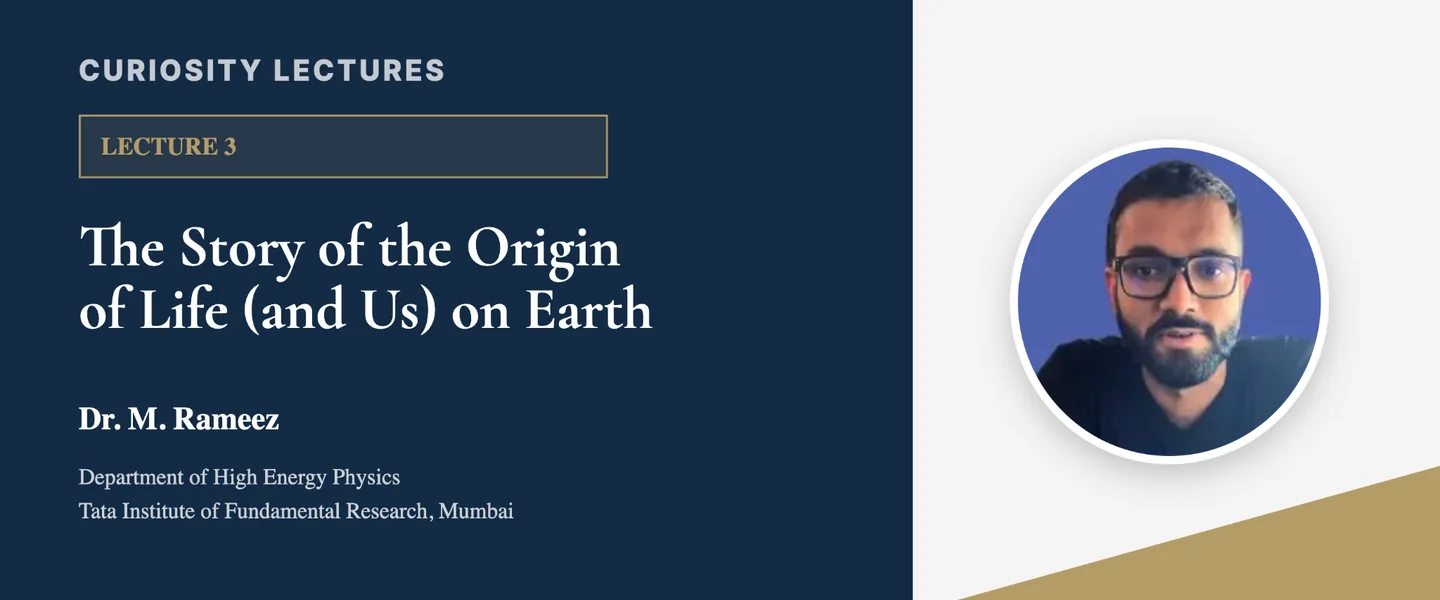
Dr. M. Rameez’s (Department of High Energy Physics, Tata Institute of Fundamental Research, Mumbai) lecture explained how life started and evolved over time. He talked about two main ideas: evolution, which shows how living things change and adapt, and abiogenesis, which studies how life first began. Although scientists are still figuring out abiogenesis, experiments like the Miller-Urey test show that basic building blocks of life, like amino acids, could form naturally in the right conditions.
- Evolution and abiogenesis — the two big ideas behind how life began and changed
- The Miller-Urey experiment and the natural formation of life’s building blocks
- How RNA became DNA, and how single cells became complex organisms
- Natural selection, genetic mutation and the branching tree of species
- The holobiont concept and our surprising dependence on microscopic life
From Molecules to Humans: The Story of Life on Earth
From Simple RNA to Complex Life
The lecture described how simple RNA molecules evolved into DNA-based life. Over billions of years, single-celled organisms grew more complex, eventually becoming multicellular creatures. This led to the development of animals, nervous systems, mammals, and finally modern humans about 300,000 years ago.
The Mechanics of Evolution
Dr. Rameez explained key ideas like genetic changes, mutations, natural selection, and how new species form. He also talked about DNA, which stores information that passes traits from one generation to the next, and how scientists use evolutionary trees to show connections between species.
We Are Not Alone — Even Within Ourselves
He introduced the idea of the “holobiont,” explaining that humans aren’t just single organisms but rely on many tiny organisms, like bacteria in our gut, to stay healthy. Dr. Rameez encouraged curiosity and critical thinking, reminding us that our understanding of life is always improving as we discover more.