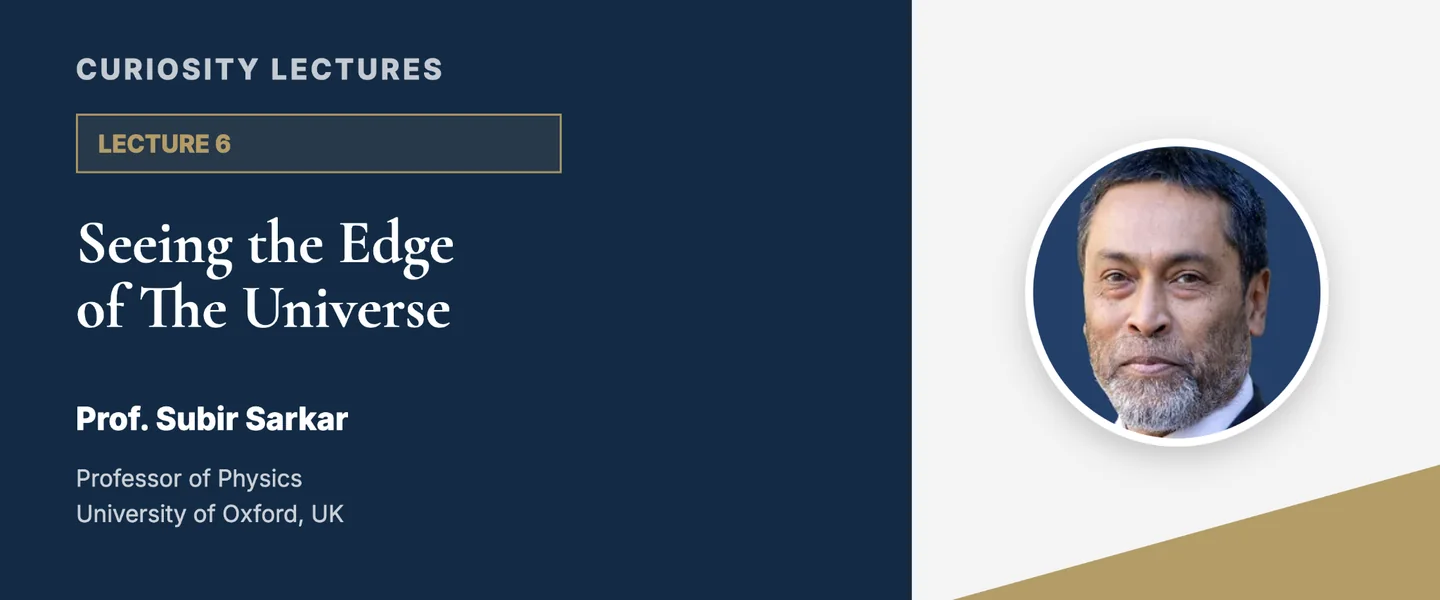
The Curiosity Lecture is an online lecture series by Abhiyan Labs, designed to ignite curiosity in young minds by exploring the fascinating world of scientific knowledge and discovery.
This lecture delves into humanity’s evolving understanding of the cosmos — from the cosmologies of ancient Greece to the modern observable universe — weaving together history, philosophy, and science into one compelling journey.
- Historical perspectives — from ancient Greek to early modern cosmologies
- How Eratosthenes & Aristarchus first measured the cosmos
- Parallax, trigonometry & light speed as tools of celestial measurement
- Olbers’ Paradox — why the night sky is dark in an infinite universe
- The evolution of telescopes and observational astronomy
From Ancient Cosmologies to the Modern Universe
Prof. Sarkar begins by tracing humanity’s earliest attempts to understand the cosmos. Ancient Greek, medieval, and early modern cosmologies each offered a different picture — from a finite universe with fixed boundaries to the radical concept of an infinite expanse, championed by thinkers like Copernicus and Kepler. Each shift in worldview was not just a scientific leap, but a philosophical one.
Measuring the Heavens
Long before modern instruments, early thinkers developed surprisingly accurate methods. Eratosthenes measured the Earth’s circumference using shadows; Aristarchus calculated the distance to the Moon and Sun using geometry. Prof. Sarkar uses these examples to introduce parallax, trigonometry, and the speed of light — building blocks that still underpin modern astronomy.
Olbers’ Paradox: Why Is the Night Sky Dark?
If the universe is infinite and filled with stars, why is the night sky dark? Prof. Sarkar uses the analogy of looking through a dense forest to explain how visibility has limits even in an infinite expanse — and why this seemingly simple question leads to profound insights about the nature and history of the universe.
The Evolution of Observational Tools
From primitive shadow measurements to powerful telescopes capable of seeing beyond the visible spectrum, the lecture charts the remarkable progress of observational astronomy. Each technological leap expanded humanity’s cosmic horizon — revealing objects, distances, and a universe far larger than any ancient philosopher imagined.
Throughout, Prof. Sarkar masterfully intertwines history, philosophy, and science to show how curiosity — the simple desire to understand what lies beyond — has driven our greatest discoveries and continues to shape our place in the cosmos.