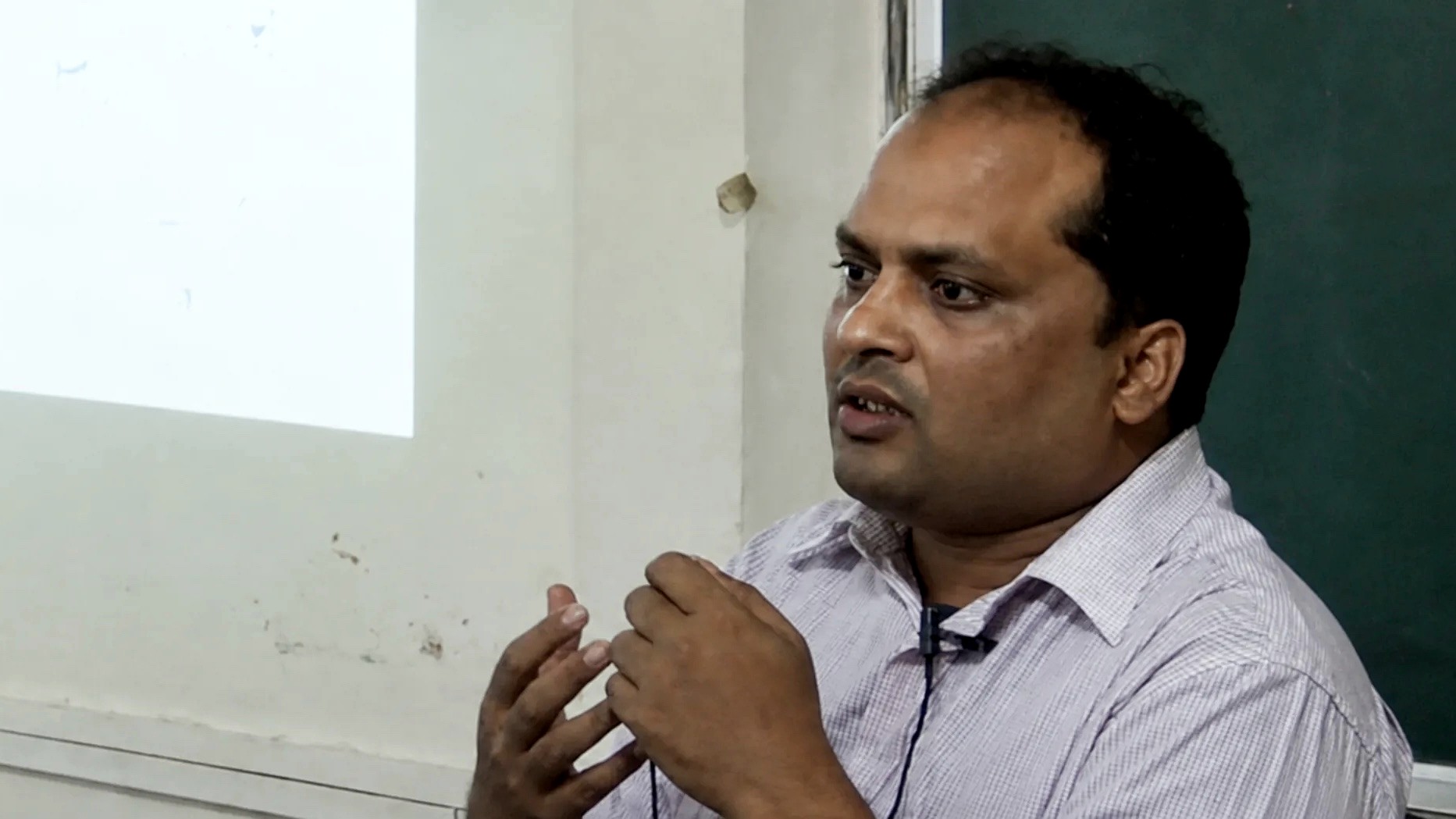
A Speech That Shaped the Nalanda Journey
Editor’s Note — Nalanda Academy, 2026
This speech was delivered by Anoop Kumar at the Tata Institute of Social Sciences, Mumbai, on 22 December 2014, at a talk organised by the Ambedkarite Students’ Association. It was later transcribed by Valliammal Karunakaran and published by Round Table India on 30 May 2016.
Reading it today, after more than a decade of Nalanda Academy’s work, feels deeply personal. Many of the questions raised here — about caste, merit, English, entrance exams, humiliation, and the loneliness of marginalised students inside elite campuses — later became central to Nalanda’s journey.
Nalanda was not built as a charity project. It emerged from these experiences, from years of witnessing how talented students from rural, non-English-medium, first-generation, SC, ST, OBC, NT-DNT and other marginalised backgrounds were kept away from higher education — or made to feel unwanted after entering it.
We are republishing this speech as part of documenting the intellectual and emotional foundations of Nalanda Academy.
Watch the Speech
The full speech was recorded at TISS, Mumbai on 22 December 2014. It is available in four parts below. The transcript follows.
In This Speech
- Why Indian Campuses Were Never Neutral Spaces
- Entrance Exams and the Hidden Design of Exclusion
- The False Idea of Merit
- What Rural Students Carry Before They Enter a Campus
- Why I Call These Spaces Brahminical
- Caste, Suicide, and the Death of Merit
- Why Many Dalit Families Did Not Speak About Caste
- The Myth of Casteless Upper Castes
- Speaking About Caste in JNU
- How Caste Is Erased
- How Knowledge Production Erases Caste
- My Engineering College Days
- The First Lecture: Marked Before the Class Began
- Caste-Based Ragging
- Marked in Red Pen
- My First Experience of Organising
- Harassment and Being Pushed Out
- When My Father Was Called to Campus
- Are These Institutions Ready for Our Students?
- The Question of Language and Democracy in the Classroom
- Looking at Structures, Not Only Individuals
Full Speech Transcript
Why Indian Campuses Were Never Neutral Spaces
My name is Anoop and I have been working on the issue of Dalit students in Indian campuses for almost twenty years now — first as a student, then, after completing my studies, as an organiser. I have been involved in other activities too, but mostly I focus on students.
About this topic — Indian campuses and caste — I share a very love-hate relationship with these campuses. I really want to destroy them, because I believe that these are not our spaces. But on the other hand, I also help our students to enter into these spaces. I have been teaching students in Wardha for the last two years, preparing them for various entrance exams. I want them to get into these spaces. But somehow I do not have the confidence that these educational spaces will provide justice to our students, because the whole design of these spaces is very brahminical. And that has been my experience, right from my engineering college days to JNU, and afterwards.
There is something built into these spaces which actually takes away the dignity of our students, and makes them feel very left out and unwelcome.
I will start with the example of TISS — the admission procedure of TISS — through which I will try to explain what I mean when I say that I hate these campuses and believe that they are inherently very brahminical spaces. It is a very big fight for us. It is a conflict: whether I want these spaces to become less brahminical, or whether I try to create a vision of an entirely alternate space.
Entrance Exams and the Hidden Design of Exclusion
I have been teaching students in a small town in Maharashtra. Last year — 2013 — twenty-four students of mine sat for the TISS entrance exam. All of them were from very humble backgrounds: SC, OBC, and NT/DNT. None of them had had English-medium schooling.
What made me ask them to sit for this exam was that there was no entrance fee for our students. Yet I still had to goad them to fill the form. None of them knew about TISS. Once they came to know that the entrance exam would be in English, they said: “No, no — we just cannot sit in this exam, we cannot compete in this.” So I had to push them. A couple of my students are sitting here today. I had to force them to apply, because I knew that they could compete. It is not that they can’t.
So they sat for the exam, and after three months of labour, twelve of them were able to pass the preliminary written exam. Out of those twelve, five students finally got through into TISS.
That was the first time I started looking carefully at the examination pattern. I had given several entrance exams myself, but I was an English-medium student, so I could not understand the exclusion from inside it. But now, looking at the kinds of questions asked — everything in English, everything online — I began to see it differently. Most of my students had never even touched a computer. So in the two or three days before the online exam, I had to bring them to my place, where they stayed with me. I had to teach them how to handle a laptop and how to sit for an online exam.
When the students came back, I asked about the question paper. They told me that about thirty percent of the questions were about English comprehension, thirty percent on current affairs, and some maths and reasoning. I could not understand: when the question paper was already in English, why did they need another thirty to forty questions to test your English again?
This is where the discrimination starts.
You don’t want our kids to come to TISS. You only want to teach your own children — English-speaking children — to become social workers, to talk about MNREGA, to talk about the poor. You don’t want those children who have actually learnt about MNREGA first-hand, to come and study in your campus.
About European football in current affairs! None of my students had even heard of that. What kind of knowledge are you testing? What is your criterion of knowledge? What is your definition of knowledge? The knowledge being tested has nothing to do with the daily lives of the majority of students in this country.
And this is just one incident I am telling you. There are thousands and thousands of students who simply cannot sit your exams — not because they are less intelligent than you — but because the examination has been designed in such a way that it excludes them.
Then I started looking at all other examinations and patterns. The same thing everywhere.
It has nothing to do with my merit or your merit. It is just that you happened to be an English-medium student and none of my students are. It has nothing to do with your intelligence or their intelligence. The whole system has been designed in a way that the concept of knowledge itself — what is knowledge? what constitutes knowledge? — has been defined so that only your own children can clear these exams.
The False Idea of Merit
Then the second concept comes into play: merit. Somehow our students get through on reservation, and then there is this whole dialogue that starts against them: “See — we scored 70% in the entrance exam, but you got through on only 45%. So you are non-meritorious.”
It is a rigged examination. It is a one-sided examination. The moment our students somehow get in through reservation, they get marked again as non-meritorious students, those who don’t deserve to be there. Completely unwelcome. They cannot even have the joy of having reached TISS — from the very first day.
I value TISS as one of the better institutions. But just imagine IITs, medical colleges! The trauma the student goes through when she has been declared non-meritorious. This is out in the open. Nothing remains hidden. The teacher knows about it; the students and classmates know about it.
And then — I am not even able to enjoy my own success, because my merit has been limited to the marks in the entrance exam.
What Rural Students Carry Before They Enter a Campus
I can tell you the stories of all those students I have coached. Out of the twenty-four students, there were twenty-two girls. All of the students who finally got into TISS are girls, from different parts of Wardha district. All from villages. They were all BSW students, wanting to do an MA from here.
I will try to give you a brief glimpse into their lives. I am not trying to romanticise anything. I am just trying to tell you what merit actually is.
All these girls wake up at 5 or 5.30 in the morning. They prepare food. They send their siblings to school. Then they take a bus at 7 am, travel some 30 to 45 kilometres to Wardha. Their classes start at 9 am and go till 12.30 pm. Then they have to go back again — cook, clean — and in between all this, find time to study.
So what I feel is: what about their merit? If they are able to get through TISS on 35% marks, 45% marks — isn’t that meritorious?
These girls — who work so hard, cook, send siblings to school, take buses and trains, come to classes, go back, cook, and clean utensils — this is not just Wardha. It is everywhere. What about those students? Every elite institution has been designed to exclude such students from the very first step of the entrance exam.
I am not the first person saying this. Dr. Ambedkar said this in his speech at the Bombay Assembly in 1926, in a debate on a Bombay University Bill. He said very forcefully: “This is wrong! By raising the level of the entrance, by making it so tough, you are actually excluding the majority of people in this country who have no tradition of education. This is the first time these people are coming into education, and you are excluding them by raising these levels.”
He did not use the word “merit” — probably because the concept had not yet gained currency — but he was talking about the same thing: making it so hard for certain students that they are designed to fail before they begin.
Why I Call These Spaces Brahminical
So when I call these spaces brahminical, I am not calling individual professors brahminical, or individual students brahminical — of course many are, without doubt — but I am not interested in blaming a few professors. I am saying that these educational spaces have been deliberately designed, in such a way, to discriminate from the first day.
Take the case of IITs. About four years back, some of us came together to study the patterns of IIT. While working, we came across many instances where Dalit and Adivasi students had committed suicide.
There is this IIT Kanpur. We went there and came to know that in the last few years there had been eleven suicides. Out of those eleven, eight were Dalit and Adivasi students. Suicide is not uncommon in higher education — in India, in the USA, in the UK also. It is nothing new in itself. But what made us look more deeply was this: out of eleven suicides, eight students — 80% — were from SC/ST backgrounds. And in IIT Kanpur, SC/ST students are hardly 10 to 12% of the student body. Think about that ratio.
If out of eleven suicides, eight are women — definitely there is a problem there. We tried to raise this, but the administration threw us out. Their standard reply was: “Our spaces are very competitive. These students were weak, they could not cope, they could not take the pressure. They got stressed and committed suicide. We have yoga classes. Why don’t they come to yoga classes?”
These are the kinds of replies we got from IIT administration. And once we started probing further, they threw us out literally, saying: “You guys are creating problems.”
Caste, Suicide, and the Death of Merit
It is not about one IIT Kanpur. We came to know that there are a large number of students who have committed suicide all over the country, and the majority belong to these two categories: SC and ST. There has to be something.
We tried to dig out some data. We brought out twenty-two documented cases. We focused particularly on central educational institutions — IITs, medical colleges. We had to focus somewhere strategic: if I say three students committed suicide in Lucknow University, nobody bothers. If I say three students committed suicide in IIT Delhi, everybody notices. So we focused on central institutions. We went and interviewed families, friends. We made three documentaries under the name of The Death of Merit, put them on YouTube, and there was a lot of hullaballoo around them. The central government said they would do something. Nothing came of it.
What came out very clearly from making these documentaries was this: out of these twenty-two students, not one was your so-called “weak student.” There is this whole tendency to equate Dalits with weak students and non-meritorious students.
If you take the case we documented from AIIMS, New Delhi — Balmukund Bharti, from Bundelkhand. He was a topper from his school. He was a gold medalist. He had been awarded by the President of India.
On his very first day at AIIMS, ragging happened and he was beaten up very badly on caste lines. He was given a room in the hostel wing where only upper-caste students lived. This was in 2006, during the anti-OBC reservation movement at AIIMS. Our students were already feeling very vulnerable. Balmukund got caught up in this. He was beaten. He was abused. On the doors of SC/ST students, upper-caste students inscribed: “You bloody SC/ST — get out of this wing.”
When students complained to professors, nothing happened. SC/ST students had to leave that wing. Balmukund had to leave too. This is how his first year started.
By his fifth year, he was not doing very well academically, but he was passing. There was one course — Social Medicine — supposed to be a very easy course. He passed in all the other courses, but this professor failed him twice. When Balmukund went and spoke to this professor, the professor said: “You came here via reservation. You don’t have the brain to be a doctor.”
Mind you — this was Balmukund’s fifth year. His final year. And the professor said: “You don’t deserve to be a doctor. I will fail you whatever you do. I don’t care.”
This was his breaking point.
Balmukund was clearly struggling throughout his five years. And one fine day, two months before the completion of his degree, he committed suicide. This was the first case where the parents came out very openly saying: this is a caste issue.
His parents were from a village in Madhya Pradesh. If you watch the documentary, the parents say there that their boy was the first one from that entire area to become a doctor. The first boy who had gone to Delhi. The first boy who could have been a doctor from the entire neighbouring region.
His father went to the National Human Rights Commission. He went to the SC and ST Commission. This is how we came to know about it, and we thought we had to do something.
My own experience at engineering college was also like that. I could not complete my engineering either. So I knew about caste discrimination in campuses. But talking to a father who has lost his son was a terrible experience. We really wanted to do something. We made a team, made more documentaries. And for the first time, caste in higher education became a small public issue. Before these documentaries, nobody wanted to believe us that caste existed in campuses.
Why Many Dalit Families Did Not Speak About Caste
There was this notion — and my own family believed in it too — that with education, caste vanishes. Caste is there in my village, in my home, but my own father and mother used to believe that once you go to Delhi, once you go to a city, caste is not there. Caste is a local problem. So we grow up believing that caste is only there among the uneducated, that with education caste vanishes.
Initially, when I looked back on this, it used to make me very angry. My father was a lawyer. He was not some uneducated person. Why did he never prepare me to defend myself against caste? Why was there no talk about caste in my home? Why was there this denial? This anger stayed with me for a very long time.
But now when I look back, I understand my father much better. And I appreciate it. Because this was the only way to grow your child. He knew how the world is. It is a denial — of course it is a denial. But there is also this tendency to protect your children. To whatever extent possible. And I have seen this tendency among all my Dalit friends: our parents do not want to talk about caste.
But what happens when you don’t talk about caste at home is that it leaves you completely defenceless when you enter these places. You have absolutely no clue how to handle a casteist, how to handle caste. And this belief is so strong — that education is a panacea for all ills, that with education all problems will vanish — that my own parents refused to believe that what happened to me in engineering college had anything to do with caste.
This is the environment through which we come in. And this is what I have always tried to fight — not just these educational spaces which are patently brahminical, but also the defencelessness we ourselves have inherited.
The Myth of Casteless Upper Castes
Then there is another issue — the whole narrative constructed after independence, that upper castes are caste-less. If you look at history, you will see that just before independence, this was not there.
For the past two years, there was this NCERT cartoon controversy. During that debate, many cartoons from the pre-independence period surfaced. I was astonished to see that many of these were targeting the caste system. Cartoonists of that time were drawing cartoons criticising caste; they were even drawing brahmin figures as symbols of brahminism. It shows that there was some space available before 1947, where there was a public discourse on caste.
But what happens after independence? In my entire growing-up period, I never saw one cartoon in a mainstream newspaper which talked about caste, although every newspaper has a cartoon section. What happened to that discourse? It was the same country. And immediately after independence, this discourse vanishes. The only anti-caste discourse that remains is with the Ambedkarites.
This whole narrative of castelessness has been thoroughly propagated: that there is no caste, that caste is past. The moment I say that I am a Dalit, the upper-caste person gets offended — because he believes I am accusing him of something. He actually believes there is nothing called caste, and that caste is just political manipulation. So what happens is that my articulation becomes criminalised. I become a criminal because I am raising an issue which is supposedly long dead, which is not there, which is no more relevant — and I am raising it because I have some politics to play. “Mayawati has sent me.”
I am not kidding. These are the statements that were being made at JNU.
Speaking About Caste in JNU
I joined JNU in 2001. In the very first semester, there was a paper on Indian Political System taught by a very well-known Marxist professor. He was teaching this course, and then came a whole class debate on reservation.
The moment reservation comes up, our antennas go up too. This was the first semester. We were about eight or nine SC and ST students among a class of about seventy. The moment reservation came up, this whole cloak of progressiveness evaporated. If the debate was on displacement, or nuclear weapons, or class divisions, the entire class took a very progressive stand. But as soon as reservation came up, there was an immediate division, and a lot of upper-caste angst came out in the open. Their questions were things like: “Sir, why do they need reservation? They now study in elite schools.”
Out of those eight Dalit students, probably I was the only one from an English-medium background. The rest were from more humble backgrounds — from the interiors of Jharkhand, Bihar, Tamil Nadu — and none of them were very proficient in English. And suddenly all of them had become “elite background students.” The professor replied that no, Dalits live in slums. I thought: I don’t live in a slum. And I don’t think a majority of Dalit students here live in slums anymore. He was linking caste to poverty. He was not talking about discrimination. He was not talking about structural problems. He was a good comrade — “anti-brahminical” — but he couldn’t explain reservation without reducing us to poverty.
Once he talked about brahminism in class, I was very happy. Genuinely happy that a professor was saying this. After that class, during a group study, one student got up and started abusing that professor — how dare he talk about brahminism, brahmins are meritorious, this is just brahmin-bashing. And everybody there agreed that there is no caste. I was sitting right there. I was invisible, I suppose.
They talked for fifteen to twenty minutes, abusing the professor, just because he had touched the question of brahminism. This disturbed me a lot.
The very next day, I went to that professor and asked if he would allow me to share my own experience with the class. I said: these are JNU students. They will go to media houses, they will become IAS officers, and they are not aware about caste. The professor agreed. The next class, I spoke for about twenty minutes. I told them about my experience in engineering college, my father’s experiences, how caste operates. There was pin-drop silence.
For the next two years — my entire MA programme — nobody talked with me in my class. I was absolutely clueless on how to deal with this much hostility and indifference. They also became a little afraid of me. They thought I was some kind of monster.
Sharing your own experience is not always a good experience in itself. You are almost naked before everyone. You are vulnerable, because all your emotions, all your experiences are out there. And there were people who looked shocked. But there was also a complete disbelief on their faces. They didn’t want to believe me. Some tried to prove that whatever I said was a lie — that I had some ulterior motive, that I wanted to become a politician.
I was also aggressive. I wasn’t a typical victim sitting there and crying. I said: I don’t want your sympathy. I am telling you this because I want you to understand what caste is. So probably they didn’t like my tone. But the message was completely lost. And the most surprising thing was that the professor also did not talk with me after that. That was more shocking than anything else.
I thought JNU was a very progressive campus. After my engineering college experience, I didn’t want to study in any campus. I was so afraid of campuses. One of my seniors forced me to write the JNU entrance exam. When I joined, it took me one week to even enter into the classroom. I used to go to the building every day and sit on the stairs, watching students pass by. I did this for days. Then I thought: okay, this is a different campus, one of the best, and supposedly very progressive. But I didn’t find any difference in JNU. They didn’t beat me up the way Dalit students were beaten in engineering college. But there was complete hostility here too.
So if your idea of progressiveness is — okay, I will not beat up a Dalit today — then you are progressive. But the question is: are you willing to engage with the question of caste? Are you open? Are you ready to listen even? Are you willing to not make me feel like a criminal?
How Caste Is Erased
Let me go back to where I started. This whole feeling that caste is a lie. That I am lying. Any Dalit who speaks about caste discrimination is a liar or is politically motivated.
However much you try to deny it — I am not going to believe you — because this happens across the spectrum. This notion is everywhere. How to fight this? How to fight this erasure of caste?
It is one thing to fight against a casteist professor who abuses you. That I can fight — somehow I will manage. But how to fight this entire erasure of caste? That “I am casteless.” That there is no caste. How do I make you believe that this is a wrong notion?
And this is a very cultivated notion. A lot of investment has been made in it. The entire Indian academia, Indian media, and the political class of this country, in the last sixty years, have invested in this narrative: that there is no caste. It has been a very deliberately constructed narrative.
How to fight this?
How Knowledge Production Erases Caste
I will take one very well-known Indian sociologist: André Béteille. He writes a thick book on Indian higher education. It doesn’t say much about caste. But at one place, he writes that state universities are performing very badly, and one of the reasons he gives is the policy of reservations. This is how caste is introduced — as a negative. As the problem.
But what about our experience of caste? If I start talking about Lucknow University, how it was in the 1980s and 1990s when my elder brothers were studying there, you won’t even believe me today. You will say I am lying again.
None of the Dalit students could enter the university hostels. Their names were on the hostel list, they had been allotted — but the upper-caste students never allowed them to reside. My brothers studied in the university for their post-graduation. Their names were on the hostel list. But they could not enter the hostels, because those spaces were entirely occupied by upper-caste students. And in state universities in UP and Bihar at that time, there were all kinds of criminals living in university spaces. Every second day there was an act of violence. The police were in the campus round the year. This was the environment.
There was a time when the hostels were not even known by their official names but by caste names. Not “Hostel 3” — but “the thakur hostel,” or “the eastern UP brahmin hostel,” or “the western UP brahmin hostel.” If you were an eastern UP thakur student, you’d go straight there and you’d get a room even without an allotment. You would be accommodated. And nobody wrote about this.
André Béteille never wrote about this. Ramchandra Guha never wrote about this. It is the upper castes who have built this whole environment — and when it fails, they blame us.
Ramchandra Guha, in 2008, wrote a very angry article about the “decline” of Mysore University. A newspaper had mentioned that three professors being considered for the position of Vice Chancellor were from OBC and SC backgrounds. Guha wrote a whole article blaming OBCs and SCs for the downfall of Mysore University — based on one line in a local newspaper, without even asking what their qualifications were.
I wrote a rejoinder and asked: who told you these three people were not well qualified? And who told you that VC posts are chosen purely on merit? Your own TISS Director didn’t come here without political backing. Every state university VC is a political appointee. You know this. But you chose to feign ignorance and blame OBCs and SCs for the decline.
And he was talking about a “golden period” for Mysore University. Which period? The British period. He himself states this. He says that while universities in Britain were aristocratic, universities in India were so egalitarian. Which Indian universities? How many Dalit graduates did these “egalitarian” universities produce before independence?
An inegalitarian society cannot produce knowledge. India is a perfect example of that. That is why you do not see any quality research happening in Indian universities. And then they blame us for it.
The JNU sociologists have even come up with this theory that “the gates of academia have been left wide open” — meaning too many unwanted people are entering. They are not able to say openly who these unwanted people are. But everybody knows.
And so, in the background of this whole discourse, if non-Dalit students discriminate against Dalit students — I am not surprised. They definitely have a ground to hate us. And that ground has been created by these scholars: by Guha, by Béteille, who never talked about our experience, who never talked about how state universities actually were before 1980, before 1990, before Mandal — but who are ever ready to blame us for everything that is wrong.
My Engineering College Days
Now I would like to take you back to my engineering college days. I did my 10+2 in 1994 and got selected into an engineering college that was supposedly one of the best colleges in North India — one of the oldest, established by the British in Kanpur. I went into this college. On the very first day, you have to show all your certificates. The moment they come to know you are Scheduled Caste, the clerk — you have to see his eyes. The moment you show your caste certificate, his behaviour changes. You will find nothing but hate in those eyes. Most Dalit and Adivasi students will vouch for this. This becomes our first experience in campus.
On that first day, we had to select our hostel and choose our hostel mates. There was this guy who was very friendly to me during admission. He was from Lucknow; I was from nearby Lakhimpur. We became good friends before the orientation programme. We said we would share a room. We were from the same department also. The moment the hostel list came out, he said: “I would not stay with you.”
I was like — why? What is the problem? My elder brother, who was there as my guardian, understood immediately. He took me away. I was just sixteen or seventeen years old. At that moment I did not understand. I thought: okay, maybe he got another friend. It never occurred to me that it had something to do with the hostel list that came out — with my caste category included on it.
The First Lecture: Marked Before the Class Began
Then in our very first lecture — an introduction class — another incident happened. About eighty to eighty-five students, ten or twelve Scheduled Caste and Scheduled Tribe students sitting somewhere in between. A very aged professor came and took introductions. Each student had to give: your name, your father’s name, your entrance test rank according to your category, and your background, your district.
So if you were Scheduled Caste from UP with a rank of 21 in the category list, you had to say: UP-SC-21. If you were from the General category, you’d say UP-GE-31. So the moment I said UP-SC, everybody knew I was Scheduled Caste from UP. I felt very awkward saying it. But everyone was saying it, so I did too.
Once the introductions were over, the professor stood up and said: “Those who are SC, ST students — they should study hard. Mayawati will not give you marks. I will give.”
This was 1995. Mayawati had just become Chief Minister of UP for the first time in May. It was a big issue — a Chamar woman becoming a Chief Minister. Lots of bad comments were passed on her, on buses, on trains. They used to abuse Mayawati. I had witnessed this growing up in UP during that period. But for us it was just something we listened to and moved on.
But this was the first incident where a professor was marking me — without even knowing me — and had linked me to one politician whom he clearly hated. I had nothing to do with Mayawati. I was just a student. I was not even eighteen. I had not even voted yet. And here I was, already linked to a politician — in front of my own classmates, with whom I was going to spend the next four years of my life.
And everybody laughed. They thought it was a brilliant joke. I don’t know whether the other eight or nine Dalit students laughed, because I did not. I was shell-shocked. How can he mark me like this? I was an 80 percenter. I had worked hard. I had come here. And you have not even taken a single class yet and you already believe none of us are meritorious. This is how my caste education began in campus.
Caste-Based Ragging
Then there was the ragging. And the ragging was completely caste-based. I am talking about 1995, before the Supreme Court ban. Teachers used to encourage ragging openly. A teacher would ask the class: “Were you ragged yesterday?” If you said no, they’d say: “You will be — and only then will you learn discipline.” It was spoken of like army training.
Ragging used to happen to everyone, irrespective of caste. But if an upper-caste student got two slaps, we got ten. That was the degree of difference. And then there were open casteist questions: “Why are you here?” And the worst part — they made some of us abuse Dr. Ambedkar.
In ragging you have to do whatever they say. They will make you dance. They will make you go naked. They will ask about your favourite heroine and describe her body parts. All these things happened. But what happened with some of us — they asked our caste. They already knew, because that is how we had given introductions: your name, your father’s name, your rank. So during ragging, senior students took some of us aside and said: “Abuse Ambedkar.”
I said: why should I abuse Ambedkar? At that time, I had no particular political relationship with Dr. Ambedkar either. Yes, my father voted for BSP. But we knew nothing much about Dr. Ambedkar — just that somebody called Dr. Ambedkar had given us reservation. I was not yet politically conscious. But a question came into my head: why are they not asking me to abuse Gandhi? Why not Nehru? Why only Ambedkar?
Some of us gave in. Some of us did not. Those who did not got beaten up.
This is how I learned about caste in campuses.
Marked in Red Pen
We also became aware that we were marked by red pen by the teachers — in the attendance register itself. Our categories were written there. So: “Anoop Kumar, Scheduled Caste” — in red pen. The list was in alphabetical order. After my name would come a general-category name with no category written. Then an Adivasi student’s name with ST written. We were literally marked.
So during vivas and in the lab, if I could not answer, they would immediately look at the list: “Oh! Quota wale ho? You have come through quota? That is why — you know nothing. Get out.”
These were the kinds of interactions I used to have with my professors.
The moment it became clear to me as a caste issue, I started looking for a Dalit faculty member. I wanted to talk about it. I had no clue what else to do. I could not even tell my parents — because we are taught to believe that the teacher is God. And here was this teacher with white hair and some fancy foreign degree, literally abusing my mother in a viva, on caste lines. I didn’t know how to tackle it. And when I started looking — this institution was seventy-five to eighty years old — not a single SC, ST, or OBC faculty member. Not one.
Some of our Dalit seniors were there, going through the same process. What they used to do was organise informal meetings. They would call us, and they used to tell us which professor was more casteist. “Don’t take his paper — he will fail you. Take this professor — he is good.” This was our defence mechanism. The only thing to do was to know which professor was the least casteist.
My First Experience of Organising
I was one of the first to begin thinking about it. Looking back now, maybe because of Mayawati and BSP, I had found some strength. Some students among us had an inclination towards organising. We started meeting. We had an official freshers’ welcome, but it was completely an upper-caste cultural activity. We used to just go, sit, eat, and come back. Then we thought: let’s have our own SC, ST student freshers’ welcome — where we can directly interact with each other, where we can tell new students what we had faced, so they could be more prepared.
We wanted to institutionalise it. Every year, some kind of function, some kind of meeting, so that new students could meet their seniors and we could reach out to them — because there was no other mechanism available.
So we tried to hold our freshers’ welcome. We were refused the space.
The administration said: “You cannot do this. This is a casteist thing. You guys are introducing caste into this engineering college.” This — because we wanted to hold our own freshers’ welcome. The teachers abusing us along caste lines was not caste. Students abusing us on caste lines was not casteism. But when we, very officially, asked for one hall to be booked — they denied us, saying they would not allow caste to enter into this campus.
This was the statement they were making.
So what we did was book a hall at a guesthouse, five kilometres away. We did our function outside. This was my first experience of organising.
Harassment and Being Pushed Out
The moment teachers came to know that we were organising, the real harassment started. There were already physical fights between our group and non-Dalit students. A lot of things happened. It is a long story and I want to cut it short here. Ultimately, they targeted me because they thought I was the one doing things.
They threw me out of the hostel. I was not doing anything illegal. I was a normal student. I used to pass. I used to do my work. I could not focus as much as I wanted, but I could do my work. They barely passed me. Then there used to be raids on my room. Every few days, four or five professors would come and raid my room — they would say I was bringing in liquor, they would bring all sorts of allegations against me. And then I was thrown out of the hostel. I had to take a room outside.
This was a very difficult time. In 1997, there was this one issue where some MCA students wanted to hold a strike. The real culprits got scot-free. The Dean took hold of one Dalit MCA student and started abusing him in front of everyone. I was also standing there.
By that point, I had been in the campus for two or three years. It had become very tough for me. I was already at my breaking point. I could not handle it. I just went and started beating the Dean — then and there, in front of hundreds of students.
After some time, I realised what I had done. I ran away from there. For two days I was in hiding. I thought they would send police and beat me up. I was very scared.
This is how my engineering college period ended. They did not allow me to come back. And I also did not want to go back. I knew that I would not be able to do it — to go back and again become a student there after what had happened. So I left engineering.
But at that moment I decided: I am going to work on this issue for my entire life.
I still could not understand why these professors hated us so much. What had we done? We had done nothing. We just entered — and from the very first day they hated us. They gave us less marks. They abused us openly in labs and vivas. And everybody treated this as a normal thing. If a Dalit student is being abused on caste lines, no upper-caste student ever raises a voice. They think: okay, he is a reserved category student, he is scoring low, he needs to be scolded.
When My Father Was Called to Campus
A few days later, my father was called to the campus. They sent three telegrams one after another. So my father came, and he took me to the professors. They said: we did all this to make him work hard. In front of my father and my elder brother, one professor said: when we scold Dalit students, call them out in front of others — we are actually helping them to study more.
My father was nodding in agreement with the professor.
This was the same professor who used to abuse my mother and sister openly. The same professor who called me junglee and said I would not be able to take a degree from there. And now he was telling my father that I was like his son, that he had always treated me like a son, that he wanted me to study hard — but I got into this politics and ruined myself.
I was very surprised at how easy it was for him to say all these things. And how difficult it was for me to convince even my own father that the professor was lying, and I was not.
So I had to go back to my hometown. I did my graduation there. I started reading Dr. Ambedkar and Phule. And little by little, I could understand: this was not the problem of one college, one university. This was a structure I was fighting against. I also got the answer to why they hated us so much.
Then in 2001, I went to JNU. But this whole experience was always with me. At JNU, there was already a strong Dalit student movement. A lot of my friends and seniors were very active. It was a very good training ground. In 2004, we started our own magazine — INSIGHT — probably one of the first Dalit students’ magazines at the national level. It ran for almost two to three years. After JNU, I have continued in this student work.
Are These Institutions Ready for Our Students?
Apart from narrating my experiences today, what I want you to know — and I am going back to where I started — is that I am still searching for answers. I don’t know whether sending my students from Wardha to TISS and JNU is a good thing or a bad thing. I don’t know. I don’t know how they are going to cope up with all this.
I don’t know whether these spaces are meritorious enough to deal with such diversity of students, because the whole academic system is designed to cater only to students from elite backgrounds. From the first day — assignments, semester patterns — our students need six months to understand even what a semester is. And there is no help. There is no proper orientation programme, nothing. And whatever orientation programmes exist, I know what happens there.
I have seen orientation programmes at TISS, at JNU, at IITs. There is this entrenched belief that our students lack something. So a good-hearted upper-caste teacher tries to “help” the student. I am not saying his intention is wrong. But his whole approach is to help the individual student, never a word about changing the structure.
The Question of Language and Democracy in the Classroom
If in this country more than 85% of students are from non-English backgrounds, from various regional languages — what is your mechanism to deal with such diversity? What is there in JNU, in IITs?
Can you imagine a classroom in premier educational institutions where only 10% of students are from an English-medium background? No, you can’t. You can’t imagine such a class. But about 80 to 85% of the total students of this country are from regional-language backgrounds. Your own classrooms are full of only elite English-speaking students. The only exceptions are students who came through reservations. Your own classroom is not a democratic space.
And then they want to make social workers out of such elite students. I am not against them. Please don’t think I am taking away your right to be a social worker or a professor or whatever you want. But I am saying that these institutions are specifically designed in a way that only you can study — and a person like me, who is one or two percent, who can speak English, can cope. The rest of the students who come from regional backgrounds — please ask them how they cope at TISS.
If TISS has not been able to develop a mechanism to address the sheer diversity of backgrounds students come from — then just imagine IITs. Just imagine AIIMS. Just imagine all your so-called “Institutes of National Importance.”
And that phrase — “Institutes of National Importance.” You know why they were given that name through a parliamentary law? Because it meant they would not have to implement reservation. Institutes of National Importance: mostly scientific institutions, mostly exempt from reservation. Because with reservations, they will not remain “nationally important.” So what you are really saying is: these institutions are too important for our students.
Looking at Structures, Not Only Individuals
And then if these students enter through reservation, obviously they will have lower marks than you. So for two or three years, that becomes their identity. Nobody questions why there is so much so-called merit among English-speaking students in this country. Why all your national institutions are filled with only English-medium students. Why your own professors only want to teach in English.
I understand that India is a peculiar country — mostly multilingual, unlike other nation-states. I understand this is a tricky situation. But have you designed your curriculum in a way that every student, after six months, can feel equal to others? Have you developed any mechanism where these students do not suffer just because they are not from English-medium backgrounds? From the very first day, everything is in English — assignments, paper presentations — and you think this is not deliberate?
I am in touch with my students here. I don’t know what to do when they tell me they are not able to cope. I feel guilty that I sent them, and I just keep hoping they can cope. I have nothing concrete to tell them. I just keep saying: TISS is very good, most professors are helpful — if you have any difficulties, please go to the professors directly. This is the only thing I could tell them.
Has this institution developed a mechanism which can actually address the diversity of backgrounds students come from? If TISS has not been able to do it, then just imagine about IITs, just imagine about AIIMS.
The moment I talk about all this, there is a lot of hostility. I am not here to blame individuals. I am saying we have to look beyond individuals now. We have to look at structures. We have to look at whether these spaces truly belong to us.
I feel unwanted here. These places are not designed for me. They were specifically designed to teach upper-caste and upper-class children. So if TISS or JNU teaches in English and has no mechanism for others — it is on purpose. It is designed that way. And so if they treat me as unwanted, it is not wrong in that sense — because I am an unwanted person here. That is what I want for us to look at: whether what we think are our institutions, actually are.
There are many other issues I want to talk about, but let me stop here. I did not know that such a large crowd would turn up. I thought it would be a small informal gathering — I should have prepared much better.
Thank you so much for patiently listening to me.
Jai Bhim!
From Nalanda Academy, 2026
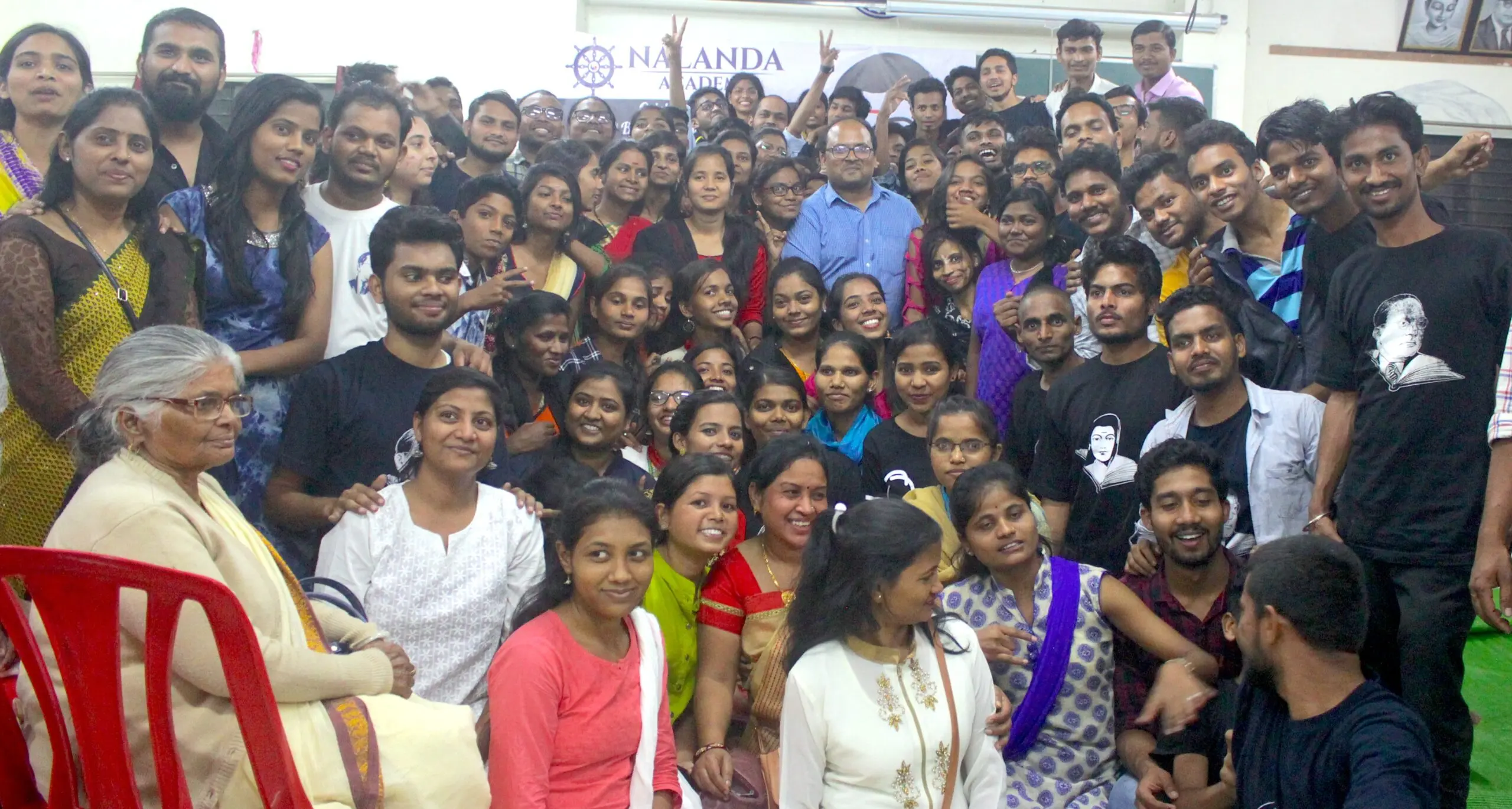
This speech was delivered in 2014. Nalanda Academy was still in its early years, working out of a small Buddha Vihara in Wardha, helping students from rural and marginalised communities prepare for the very entrance exams this speech describes.
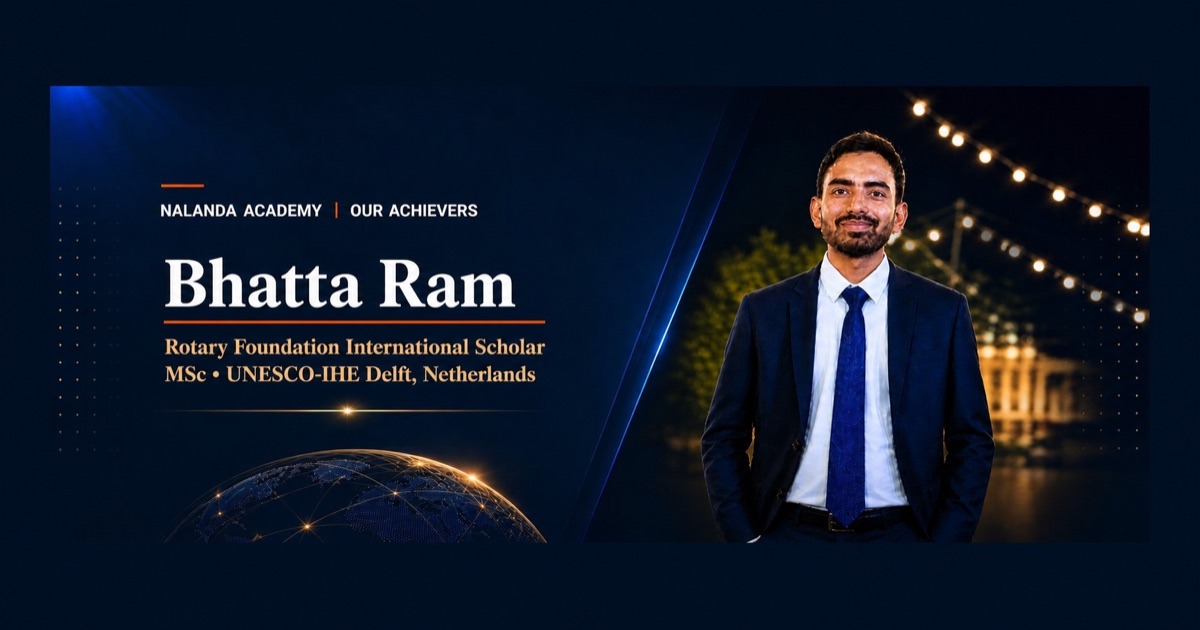
Many students from those early batches went on to study at leading universities in India and abroad. Some of them sat through the same humiliations this speech names. Some returned to become mentors for the next generation.
The work of Nalanda has never been simply about clearing entrance exams. It has been about building the conditions — preparation, language confidence, community, political clarity, and a sense of dignity — that allow a student from a village to enter an elite campus and not feel like they are trespassing.
This speech is part of Nalanda’s intellectual foundation. It explains, more honestly than any institutional document can, why this work exists — and why it still needs to exist.
We publish it here without editing the anger, without softening the politics, and without pretending that the conditions it describes have been resolved.
They have not.
From This Speech to Nalanda Academy
This speech offers one part of the story: the experiences, questions, and struggles that shaped Anoop Kumar’s work with students from marginalised communities. To see how this journey grew into Nalanda Academy and its wider movement, read the full Nalanda journey.
Read the Nalanda Journey