The Curiosity Lecture is an online lecture series by Abhiyan Labs, designed to ignite curiosity in young minds by exploring the fascinating world of scientific knowledge and discovery.
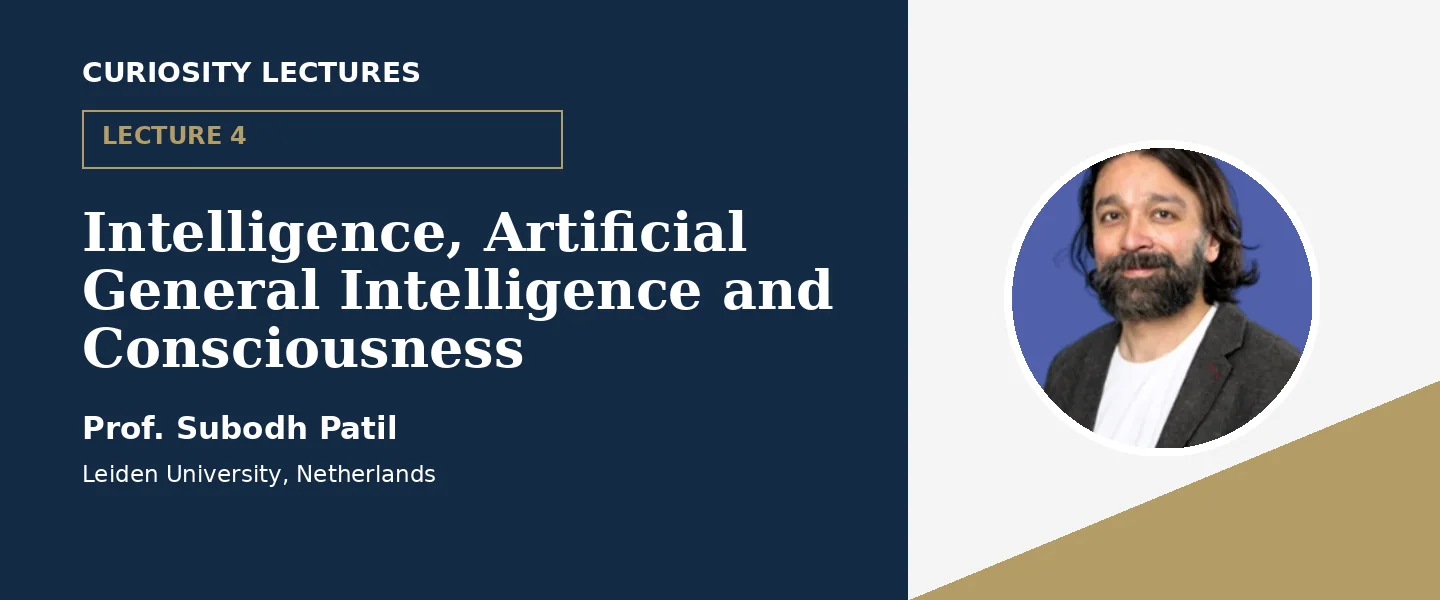
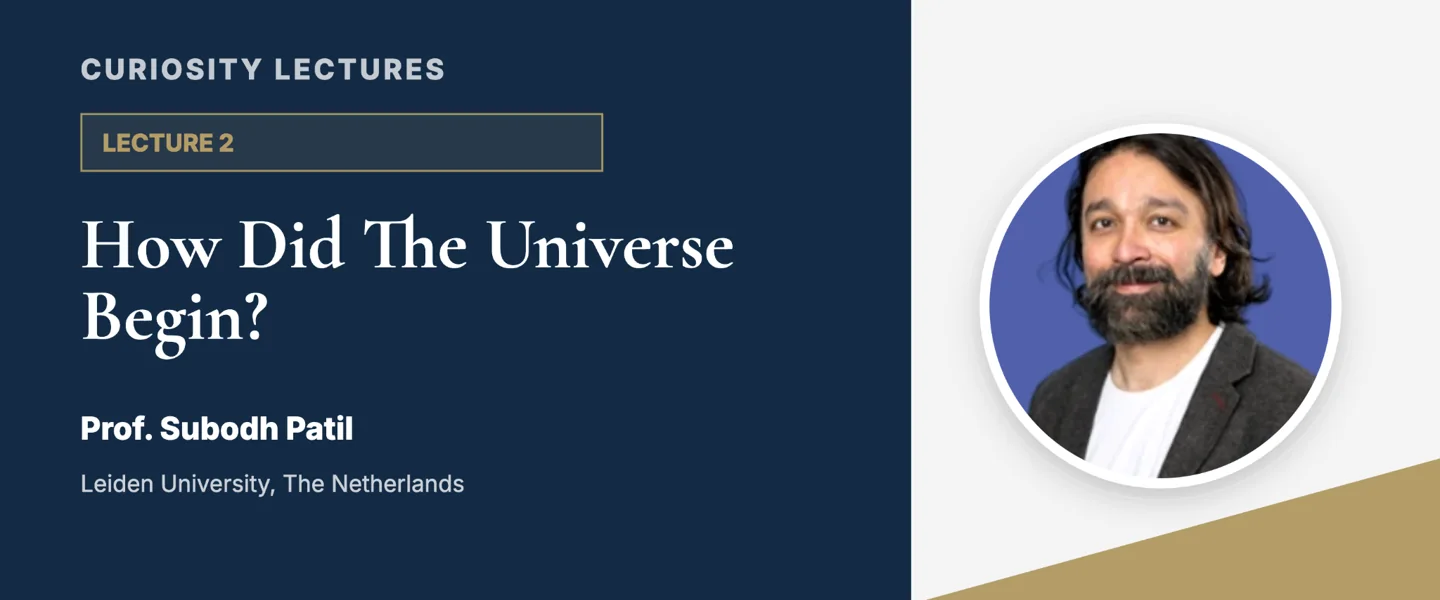
In this lecture, Professor Subodh Patil (Leiden University, The Netherlands) provided a profound exploration of cosmology and humanity’s understanding of the universe’s origins. He began by distinguishing science as a method of inquiry that answers “how” and “where” questions, leaving “why” questions to personal interpretation. Highlighting the predictive power of science, he explained that it relies on models that are continuously tested and refined to align with observations.
- Science as a method of inquiry — what it can and cannot answer
- The Big Bang model and the evidence that supports it
- Cosmic microwave background radiation and the redshift of galaxies
- Einstein’s general relativity and Hubble’s discovery of cosmic expansion
- The philosophical humility required in scientific exploration
From the Big Bang to an Expanding Universe
The Big Bang: Science’s Best Model
Professor Patil described the evolution of cosmology from philosophical and theological speculation to rigorous scientific inquiry. He introduced the Big Bang model as the most consistent explanation for the universe’s origin, supported by evidence such as cosmic microwave background radiation and the observed expansion of the universe, as discovered through the redshift of distant galaxies.
Einstein, Hubble and Key Milestones
The lecture detailed key milestones in cosmology, including Einstein’s theory of general relativity, which redefined gravity as the curvature of space-time, and Edwin Hubble’s discovery of the universe’s expansion. Professor Patil explained how elements in the universe have consistent spectral fingerprints, allowing scientists to deduce motion and composition, and how the Big Bang model predicts key cosmic features with remarkable accuracy.
The Limits of Knowledge and the Joy of Curiosity
Addressing questions about the nature of space, time, and the limits of human understanding, he acknowledged the challenges of studying the universe’s earliest moments and the potential unknowability of some questions. He emphasized the humility required in scientific exploration and the liberation in accepting the limits of knowledge, fostering curiosity and critical thinking about the cosmos.