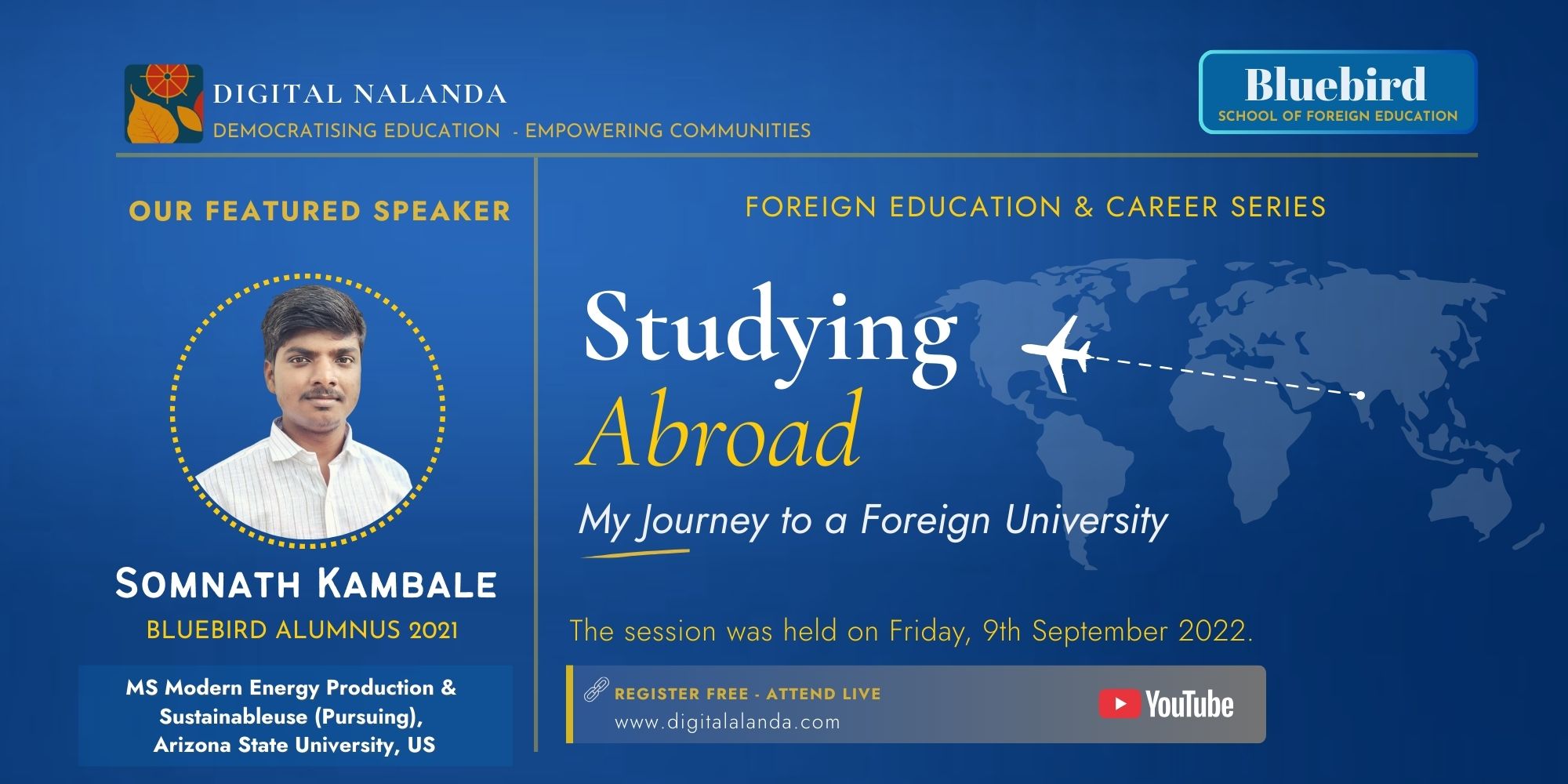
In a small village in Solapur district, Somnath Kambale grew up in a tin-roof house where his parents worked as daily wage labourers earning less than ₹150 a day. Today, he is completing his Master’s degree at Arizona State University in the United States. His journey from rural Maharashtra to one of America’s largest universities is not just inspiring — it is also a practical roadmap for students from modest backgrounds who dream of studying abroad.
As shared in Digital Nalanda’s Bluebird Foreign Education Series | September 9, 2022
“If I can, everyone can. You just have to make up your mind — if someone can go there, I can too.”
A Village, A Tin Roof, and a Dream
Somnath grew up in a small village in Solapur district, Maharashtra. His father earned ₹80 a day labouring in the fields; his mother, ₹60. Their home was a 10×10 tin-roof structure — scorching in summer, leaking in the rains, bitterly cold in winter.
“I am not sad that I suffered all this,” Somnath says. “It is normal life for someone growing up in that village.” What was not normal was his family’s hunger for education. His mother — illiterate herself — dreamed fiercely that her children would one day work in the shade, not under the blazing sun. Today, his brother and sister are both pursuing PhDs. Somnath is completing his Master’s at Arizona State University, USA.
Getting Here — The Honest Version
After scoring 83% in Class 10, Somnath chose a Diploma in Mechanical Engineering — not out of passion, but necessity. His family pawned his mother’s jewellery to pay the ₹30,000 fees. He left his village at 16 for the first time. He got placed at a steel factory, earning ₹20,000 a month. Comfortable enough. But after two years on the shop floor, he was clear: “I wasn’t made for this. If I stay, I will become a lifetime labourer.”
He quit, completed a Bachelor’s in Engineering, and turned toward studying abroad — with no GRE, barely functional English, and no mentor in sight. What he did have was the willingness to search.
Finding Your University — Build a Spreadsheet First
One of the most practical lessons from Bluebird alumni: don’t start with dreams, start with a spreadsheet. Begin with the QS World University Rankings. If you are applying for the NOS or Maharashtra Government Scholarship, you must target universities within the top 100 or top 500 — filter accordingly.
For each shortlisted university, note: whether your course is offered, eligibility criteria, application deadline, required documents, and language test requirements — IELTS, TOEFL, or PTE. Most students target the September/October intake. One critical detail for scholarship applicants — you need an unconditional offer letter. Ensure all conditions are cleared before the scholarship deadline.
Somnath applied to only one university — Arizona State University’s Sustainable Energy Management programme, which matched his profile and required no GRE. It worked. But he is the first to say: apply to more than one. Give yourself options.
Clearing IELTS — Tips That Actually Work
Somnath prepared for IELTS by working 7–8 hours a day — reading newspapers, listening to podcasts, practising writing. He cleared it with a Band 7. Most universities require a minimum of 6.5.
A few tips that Bluebird alumni swear by
For Listening
Watch English television series consistently; by the third or fourth episode your ear naturally adjusts to the accent.
For Writing
Find vocabulary and connector word lists online and practise weaving them into essays naturally.
For Reading
Understand what the question is actually asking before scanning the passage for answers.
One overlooked tip: after registering for IELTS, check your confirmation email carefully — there is often a link at the bottom offering one free month of official preparation material. Most students miss it. Find it and use it. And if your undergraduate degree was entirely in English, ask your college for a Medium of Instruction certificate — some universities accept this in place of IELTS.
Watch the full video here:
Funding — Ask More People Than You Think To Ask
Somnath’s course would cost upwards of ₹60 lakh. His family had never seen that money in one place. He applied for the Maharashtra Government Scholarship through Digital Nalanda mentors — thanking Shubham Meshram and Suryakant Buchunde for guiding every document. He was placed on the waiting list, then selected when numbers increased.
Even then, gaps remained. He reached out to the Ambedkar Association of North America and the Human Metta Foundation — both supported him. Other funding options worth exploring: NOS (National Overseas Scholarship), DAAD for Germany, Fulbright for the US, and Chevening for the UK. The point is simple: ask more people than you think you need to.
“There are many people who will help you,” Somnath says. “You just have to ask them.”
First Train. First Plane. First Country.
At 26, Somnath had never travelled beyond Maharashtra. He and his brother took a train to Delhi for the visa interview — barely managing to book confirmed tickets. The visa officer barely asked him anything. One look at the scholarship documents and it was approved.
On 15th August, he boarded his first ever flight. He arrived four hours early, terrified of missing it. A stranger at the airport — moved by his story — gave him $100 and walked him through immigration and boarding. When word reached his village, people came to congratulate his family.
Do It Better Than He Did
Somnath wasted seven months during the pandemic without direction. He skipped the GRE. He applied to one university. He made every mistake — and still made it. But his honesty about those mistakes is the lesson itself.
“I am only telling my story so you can study it. Take help from mentors. Give GRE. Apply to more than one university. Do what I didn’t do — do it better than me.”
“In one life, you should try your best. I don’t know how successful I will be — but I will definitely find ways to grow. And you can too.”
The story of Somnath Kambale is part of Digital Nalanda’s ‘Foreign Education and Career Series.’ The series consists of 16 online sessions conducted in 2022 by Nalanda alumni who are studying at leading universities abroad. In these sessions, they share practical insights on applying to universities overseas, visa processes, cultural adjustments, the experience of studying abroad, and career guidance related to their respective fields.
You can access all Foreign Education and Career Series sessions in this YouTube playlist:
▶ Watch Full Playlist on YouTube