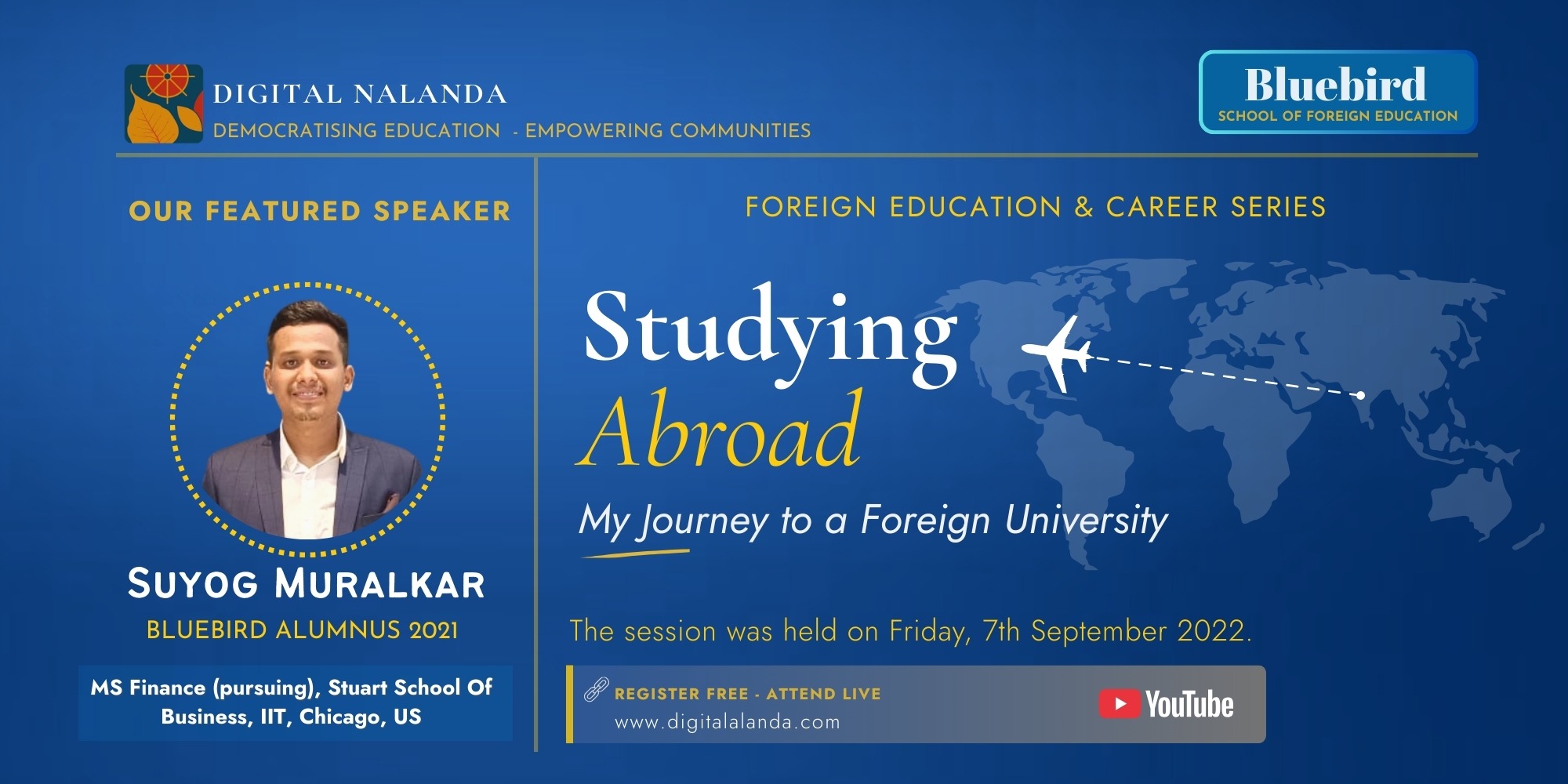
Suyog Muralkar grew up in Wardha, Maharashtra, in a farming family — and is now pursuing a fully-funded Master’s in Finance at Stuart Business School in Chicago on the National Overseas Scholarship.
But the most striking thing about his journey is not the destination. It is how deliberately — and how early — he planned every step of the road there.
The Biggest Advantage: Starting Early
Suyog was one of the youngest students in Digital Nalanda’s first Bluebird batch in March 2021 — because he joined while still attending college lectures. That early start, he says, made all the difference.
“I have seen people trying for four to five years just to get into a foreign university. In my case, I started preparing in college itself — and I completed the entire process in eight to twelve months.”
His advice is clear: if you are in your third or final year of college, that is the right time to begin. Start preparing for GRE and IELTS. Build your profile — projects, internships, relevant experience — tailored to the course you want to apply for. Every month of early preparation saves a year of delay later.
Choosing the Right Country and University
Start with the country, then the field, then the university. Germany and Europe are ideal for mechanical and automobile engineering. The US and Canada are strong for computer science, data science, and finance. Singapore and Hong Kong are emerging hubs for finance in Asia.
For ranking, target universities within the top 100 on the QS World University Rankings — and ideally within the top 50 if applying for a government scholarship. For applications, Suyog recommends a practical rule: two ambitious picks, two mid-range, two safe. Application fees add up quickly — apply strategically.
Cracking GRE — It Is Not as Hard as It Sounds
Suyog prepared for the GRE for four to five months. Though he ultimately received a waiver due to Covid-19 testing centre closures, he is firm: do not count on a waiver. GRE is becoming compulsory again — treat it as a mandatory part of your profile.
The quantitative section covers Class 10 level mathematics. The verbal section requires preparation of 6,000 to 7,000 words — this is where most students struggle. His approach: dedicate consistent hours, review weak areas regularly, and use three or four standard books rather than excessive material. He has seen friends from Marathi-medium schools score 320–330 out of 340 after six months of focused preparation.
IELTS in 20 Days — A Strategy That Actually Worked
Suyog had only 20 days between booking his slot and the exam. He completed the official free IELTS preparation course — sent via email after registration and missed by most students — in five days. He then solved all 16 Cambridge IELTS books at four tests a day over 10 to 12 days.
For speaking, he used Makkar’s Cue Cards and practised with his younger brother, who held a stopwatch while he spoke for up to five minutes on random topics.
In India, most students don’t speak English with friends or family. Find a speaking partner — a sibling, a classmate, anyone — and practise out loud. Consistency is more important than perfection.
The Funding Question — Scholarships and Backup Plans
Suyog was selected for the National Overseas Scholarship (NOS) — a central government scholarship awarded to 125 students from across India each year, requiring admission to a university ranked within the top 50 on the QS list. He cleared it on his first attempt.
But he is honest: many deserving students do not get it. That is why having a backup plan matters. The Maharashtra Government Scholarship is a strong option for state students. For those without collateral, institutions like MPower, Credila, and Avanse offer collateral-free education loans without requiring a co-signer. Several universities also provide partial scholarships based on GRE score, academic record, and internship experience.
SOP and LOR — Your Story, Your Voice
The Statement of Purpose and Letter of Recommendation together account for nearly 60% of an admission decision. Universities want to understand who you are, why you want to study this subject, and why you have chosen them specifically. Showing a weakness — and how you overcame it — can be more compelling than presenting a perfect record.
“SOP is your transparency. Write from your schooldays — your projects, internships, weak points, and how you overcame them. The university reads your SOP and imagines your personality. Make that image honest and real.”
For resume building, check sample resumes published by universities like MIT, Stanford, and Cornell. Compare your resume against those standards — the gap will show you exactly what to improve.
What Life Is Like on the Other Side
Chicago has been full of surprises. The curriculum at Stuart School of Business is deeply practical — finance classes, for instance, are built around Python and computational tools rather than theory alone. The welcoming professors and small-talk culture have made the transition smoother than expected.
Foreign universities, Suyog notes, allow students to switch their career path completely. A civil engineer can move into data science or finance by doing relevant internships and building the right profile. That flexibility is one of the best aspects of studying abroad.
Suyog started planning from his college bench in Wardha, while most of his peers were still deciding whether to try. That gap — not of intelligence or privilege, but of timing and intention — is what carried him from a village flour mill to a business school in Chicago. The road is available to anyone willing to begin it early enough to walk it calmly.