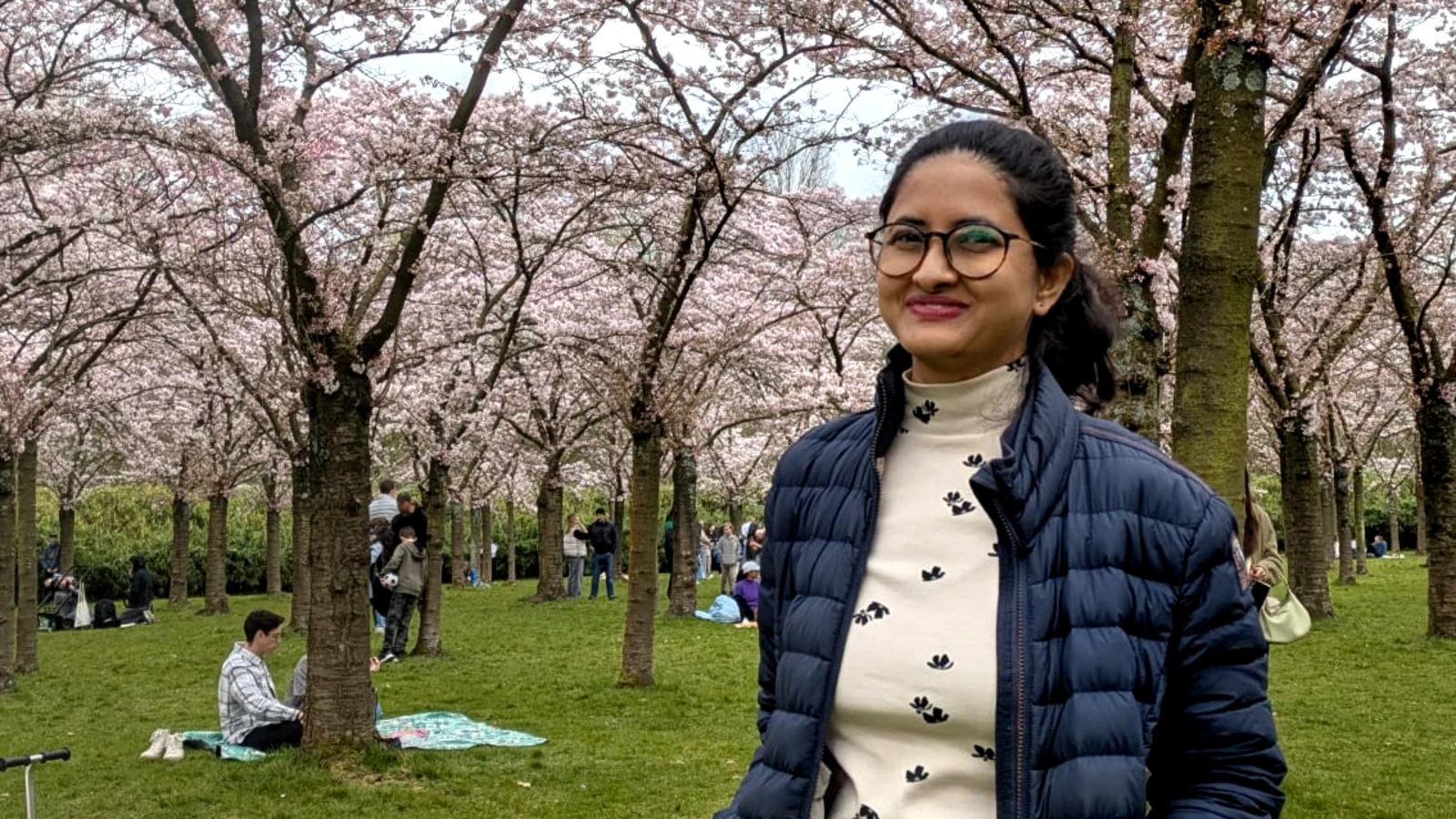
Arati did not grow up imagining herself in a European university. A PhD abroad felt distant — not something she saw for herself. Today, she is pursuing a fully funded PhD in Anthropology at the University of Amsterdam. Her journey is not just about achievement, but a clear pathway for students who believe such opportunities are not meant for them.
The Beginning: A Shift in Possibility
Arati joined Nalanda Academy in 2016. It was here that she first began to take higher education seriously.
When she later applied for an M.Phil at the Tata Institute of Social Sciences (TISS), Mumbai, even that felt like a stretch.
“I thought, okay, maybe a Master’s… but M.Phil? Not at all.”
It was encouragement from her mentor Anoop Kumar that pushed her to apply — and she got in.
At TISS, something began to shift. Surrounded by peers and alumni who were applying abroad, the idea of studying internationally slowly started to feel real.
The Turning Point: Applying Abroad
During the COVID period, while enrolled in TISS’s integrated M.Phil–PhD programme in Women’s Studies, Arati began working on her research proposal. It took her nearly a year to complete.
Once ready, she applied widely — around 50 to 60 universities across Europe and the United States. Responses came from about 10 to 15.
Two professors showed strong interest — one at IISS Netherlands and another at the University of Amsterdam.
“The interview was not really an interview. It was more about understanding each other’s research.”
When a professor aligns with your work, she says, much of the process is already in place. The University of Amsterdam sent her offer letter in time for her scholarship deadlines. In fact, she found the process simpler than many Indian entrance systems.
What Matters Most: Understanding the Process
For Arati, the application process is not mysterious — it is structured, and it revolves around a few essential components that require time and clarity.
The Research Proposal
At the center of it all is the research proposal. This is the most important part of the application, where your ideas take shape. It requires a clear research focus, a well-connected literature review, a strong central question supported by sub-questions, and a thoughtful methodology. Ethical considerations and references are equally important.
Arati emphasizes that this is not something to rush — it often takes months of consistent work to develop properly.
The Statement of Purpose
Alongside this, the Statement of Purpose becomes your personal narrative. It connects your life experiences with your academic interests — where you come from, what has shaped you, and why you want to work on a particular topic, at a particular university, with a particular professor.
For students from Nalanda, she believes this is a strength. The stories are already there — they simply need to be trusted and articulated clearly.
The CV
The CV, especially in the European format, is another important document. It is not just a list of qualifications, but a reflection of your academic journey and interests. Research interests, academic background, work experience, publications — even online writing — and public speaking engagements all contribute to it.
Even small details like hobbies matter, as they are often read more closely than one expects. Academic references, too, play an important role in strengthening the application.
Transcripts and Language Requirements
There are also practical steps that require careful timing — requesting transcripts well in advance, preparing proof of English proficiency through IELTS, TOEFL, or a Medium of Instruction certificate, and checking specific requirements for each university.
How She Approached the Process
Arati’s approach to applying abroad was simple but disciplined. She began by using QS World Rankings to shortlist universities, then spent time understanding faculty profiles and identifying where her research interests aligned.
She reached out to professors directly, sharing her work and expressing interest, and applied widely across institutions.
The process required patience. Receiving responses from 10 to 15 universities out of 50 to 60 applications, she says, is normal — and part of the journey.
Funding: More Accessible Than It Seems
One of the biggest concerns for students considering studying abroad is funding. Arati’s experience shows that the possibilities are wider than they often appear.
There are multiple scholarships available — including the Maharashtra Government Overseas Scholarship, National Overseas Scholarship (NOS), Inlaks Shivdasani Foundation, Fulbright-Nehru Fellowship, Orange Tulip Scholarship, and DAAD — each offering different kinds of support.
In Europe, many PhD positions are structured differently. They are often project-based and come with a salary — around €2,500 per month — removing the need for a separate scholarship application altogether.
“If funding is a problem in the beginning, write to the university. They often have support for visas, flights, and initial expenses.”
The Most Important Advice: Plan for a Year
Looking back, Arati emphasizes that this entire journey requires time — at least a year of consistent effort.
Working on the research proposal, preparing for English tests, arranging transcripts, and collecting scholarship documents — all of these processes need to run in parallel.
The challenge, she says, is not just difficulty, but consistency.
“Many people don’t make a timetable. They lose consistency. They get frustrated. The ones who plan and stick to it — they succeed.”
Beyond the Destination
Arati’s journey is not just about reaching the University of Amsterdam. It is about expanding what feels possible.
From not imagining herself beyond a Master’s degree to pursuing a fully funded PhD in Europe, her journey reflects a quiet but powerful transformation — from doubt to clarity, from hesitation to confidence.
At Nalanda, such journeys begin long before the destination becomes visible.