


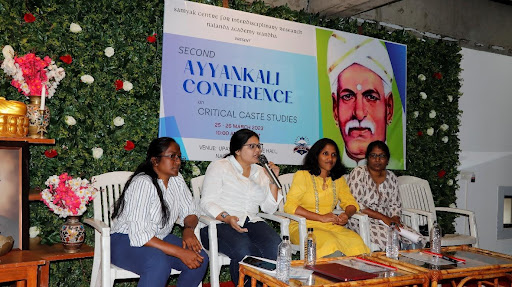
Ayyankali was a pioneering social reformer who fought relentlessly for the rights of Dalits, who were ostracized, excluded, and violently persecuted in a caste-apartheid society. His struggle for dignity, access to education, and democratic participation invited severe backlash from dominant castes, often resulting in violent confrontations. Despite this, Ayyankali persisted in his efforts to democratize public spaces, expand educational opportunities for Dalits, and foreground their participation in politics—laying the foundation for long-term social transformation.
To honour his legacy, the two-day 2nd Ayyankali Conference on Critical Caste Theory was organized by Samyak Research Centre (Nalanda Academy), Wardha, on 25–26 March 2023, with the aim of democratizing academic spaces for marginalized scholars and engaging with global interventions that challenge hegemonic and oppressive knowledge systems.
The conference accepted 36 research papers, all presented by scholars from marginalized communities working within academic institutions located at the periphery of Indian academia.

Day 1 – March 25, 2023
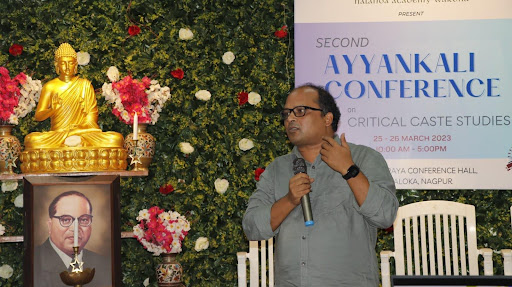
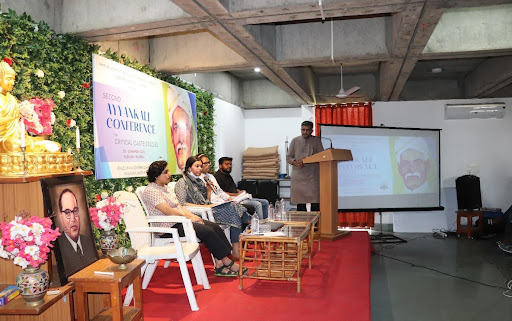
Inaugural Address – Anoop Kumar
The inaugural address was delivered by Anoop Kumar, who reflected on the systemic struggles faced by individuals from marginalized communities in gaining recognition within academic spaces dominated by upper-caste privilege. He spoke about pervasive discrimination, the structural exclusion of anti-caste leaders from mainstream academic discourse, and the narrow definitions of “merit” that reinforce inequality.
He highlighted initiatives such as Insight Magazine and the Nalanda Academy platform, which seek to challenge dominant epistemologies and enable marginalized communities to produce knowledge rooted in their own lived realities. The Ayyankali Conference on Critical Caste Theory, he emphasized, is one such collective platform where scholars can come together to share experiences and generate counter-hegemonic knowledge. Drawing inspiration from Ayyankali’s repeated yet resilient attempts to establish schools for “untouchables,” he underscored education as a central tool for empowerment and social justice.
Panel 1: Ambedkarism, Social Reform, and Legal Systems
The first panel, moderated by Ravikant Kisana, featured four speakers from different universities across India.
- Prashant Randive presented a historical analysis of Matang mobilization and their position within the Ambedkarite movement.
- Vishakha and Mayuri jointly presented a paper on custodial deaths in India, critically examining police interrogation practices and existing legal mandates.
- Deepak explored the intersection of caste and disability, highlighting the compounded marginalization experienced by disabled Dalits.
Panel 2: Community Assertion and Public Spaces
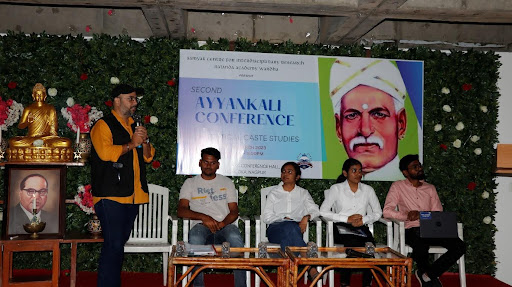
The second panel of the conference, moderated by Nilesh, focused on the assertion of caste communities and the politics of public and community spaces.
- Sargam (University of Delhi) presented her research on the Dabgars community located across Rajasthan, Uttar Pradesh, and Gujarat, examining their struggles for dignity and social recognition.
- Sweta (University of Pune) discussed the role of Buddha Viharas as crucial sites of community assertion and collective identity.
- Yuvraj (TISS, Mumbai) explored questions of aesthetics, beauty, and Navayana Buddhism, offering a critical engagement with dominant cultural frameworks.
- Reema (IIT Bombay) analyzed gendered spaces such as Kottil—the workspaces of the Moosaris (Kammala / Viswakarma caste)—highlighting how caste and gender intersect in the organization of labour and space.
Panel 3: Women, Agency, and Community Struggles
Moderated by Sapana Jambhulkar, this panel featured three women scholars from premier Indian institutions.
- Suvarna More (Savitribai Phule Pune University) discussed women’s emancipation through the lens of neo-Buddhist religious conversion.
- Bincy (IISER Bhopal) presented autobiographical life histories of two influential Christian Dalit women—Saleena Prakkanam and Mariyamma Chedathi.
- Shainal Verma (IIT Delhi) offered an auto-ethnographic account of Ambedkarite Mahila Mandals and their impact on feminist praxis in South-West Delhi.
Panel 4: Education, Ambedkarism, and Social Reform
Moderated again by Dr. Ravikant, this panel focused on Ambedkarite educational philosophy and oral histories.
- Dharmveer Singh, Nidhi Singh and Tajveer from University of Delhi presented research on the biographies and struggles of Ambedkarite women teachers in Delhi.
- Shubham from Central University of Haryana examined Ambedkarite educational philosophy and the forms of resistance generated through the movement.
Ayyankali Memorial Lecture (Online)
The memorial lecture featured a transnational dialogue on caste–race intersections in Caribbean Studies. The session included Dr. Charissa Granger (University of the West Indies) and Dr. Francio Guadeloupe (University of Amsterdam), and was moderated by Nalanda alumna Arati Kade, a doctoral candidate at the University of Amsterdam.
Day 2 – March 26, 2023
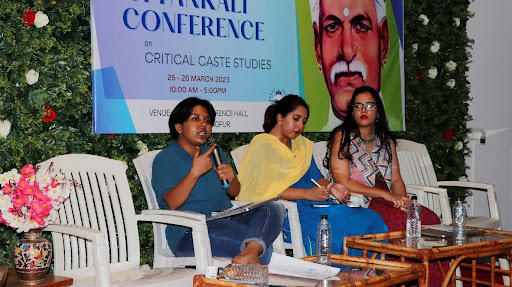
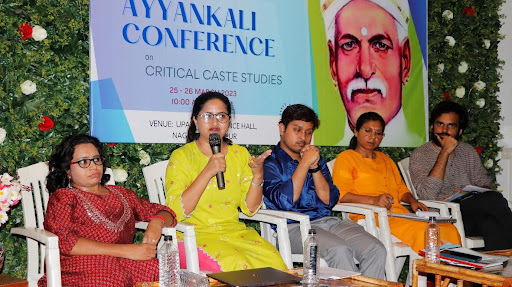
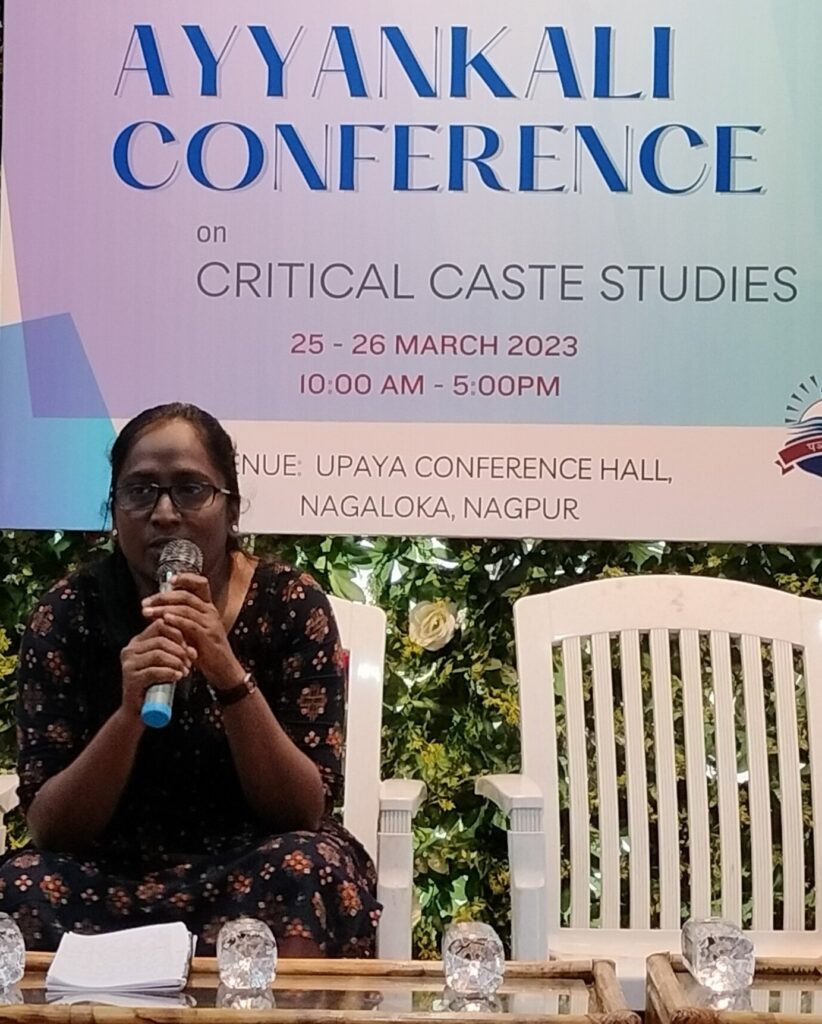
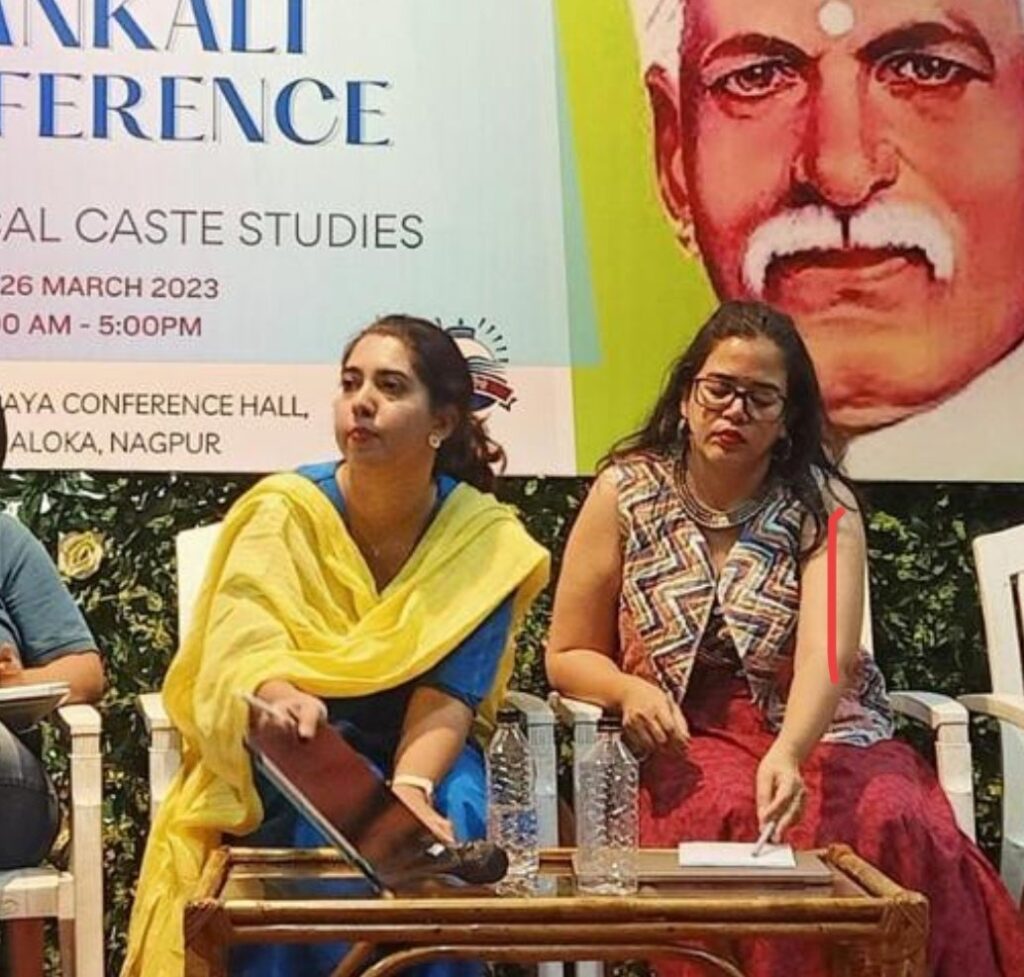
Women and Ambedkarite Leadership
Sapana Jambhulkar, Managing Director of Digital Nalanda and a core founder of Nalanda Academy, delivered a talk on Women and Ambedkarite Leadership. She connected the historical contributions of Ambedkarite women with her own lived experiences and educational journey—first as a student at Nalanda Academy and later as a leader shaping its digital vision.
Panel 5: Language, Music, and Counter-Publics
Moderated by Subodh, this panel featured five presenters and four papers.
- Shakar Naik, a TISS graduate, discussed the linguistic uniqueness and challenges faced by the Lambani community of Karnataka.
- Maya Somkuwar, a PhD scholar from TISS, analyzed Dalit counter-publics and their influence on Maharashtra’s Bheemgeet tradition.
- Rahul Bishnoi (IIT Gandhinagar) examined the prose of Dalpat Chauhan.
- Dr. Swarnmala and Arati jointly presented a paper on the Padar worn by Indian women, interrogating Brahmanical-capitalist aesthetics and the politics of gaze.
Panel 6: Ambedkarite Grassroots Histories
Moderated by Dr. Ravikant, this panel featured three scholars:
- Ashna (NLSIU Bengaluru) spoke on Ambedkarism, social transformation, and the role of organization and institutionalization.
- Vaishali Khandekar (IIT Hyderabad) presented ethnographic fieldwork on the emergence of the Bhim Army in Uttar Pradesh.
- Gorvika Rao traced Ambedkarite movements in Delhi from the 1960s to the 1990s, highlighting shifts in Dalit socio-political consciousness.
Panel 7: Poetry, Aesthetics, and Digital Resistance
Moderated by Nilesh, this panel featured scholars from reputed institutions.
- Diwaker examined Dalit digital media ventures and the systematic exclusion of Dalits from mainstream media.
- Prasenjit Sarkar analyzed caste modernity and technological change.
- Megha Kshirsagar explored assertive women characters in films by Pa. Ranjith, using a caste and gender lens.
Panel 8: Navayana Buddhism, Lost Histories, and Leaders
The final panel, moderated by Subodh, featured two scholars.
- Harikrishnan presented research on Kavarikuklam Kandan Kumaran, a close associate of Ayyankali, reconstructing his life and contributions through neglected archives.
- Aravind, a PhD scholar from Jawaharlal Nehru University, compared B. R. Ambedkar’s Navayana Buddhist movement with Iyothee Thass’s Tamil Buddhist movement.
Vote of Thanks
The conference concluded with a vote of thanks by Anoop Kumar on behalf of Samyak Research Centre. He thanked all participants for their scholarly contributions and announced plans to publish the conference papers in an edited journal or book. He also expressed heartfelt gratitude to his team and Nagaloka for providing the space and support necessary for the successful organization of the two-day conference.


